Which summer tyre tread should you choose?
Every motorist has to answer this question for themselves, depending on budget and their own typical conditions for using the car in the summer season. To make it easier, let’s describe the main types of summer tread and get to grips with the details: the advantages and drawbacks of each type.

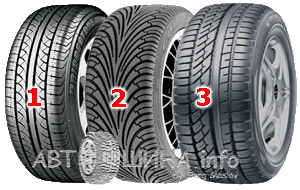
There are three main types of summer tyre tread: classic symmetric, directional and asymmetric. Each of these types has its own features, advantages and drawbacks, so do not rush to conclude that any one of them is unconditionally the best; it may well not be so for your conditions at all.
In general, whether you choose classic tyres or tyres specialised for particular conditions, you need to understand that no tyre, however good and however expensive, will forgive a serious mistake or an irresponsible attitude to driving. You should always rely on common sense, the current situation on the road and the rules of safety, not on the idea that a pricier tyre will let you do something foolish.
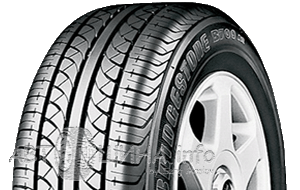
Classic symmetric tread is usually found on mid-range and budget tyres and is universal in terms of operating conditions. This tread moderately clears water from the tyre’s contact patch with the road, feels reasonably confident on the motorway, in town and even on unmade roads, is not too noisy, lasts a reasonably long time and is, in truth, ideal for the vast majority of level-headed motorists. Its versatility and affordable price are exactly what make this type of tyre so appealing.
On classic symmetric tread you categorically should not push your speed too far, especially in corners and on a wet surface, but within the speed limits such tyres feel more than confident in every regime and on every surface.
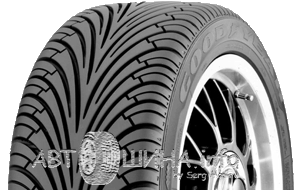
A directional tread pattern usually signals that a tyre is specialised for “wet” conditions. Such a tyre feels noticeably more confident than a classic one when you hit a puddle or drive through heavy rain (resistance to aquaplaning), but because the outer edges of the tread are less stiff (thanks to the water-clearing channels), it will most likely show reduced directional stability (the ability to hold the road in corners at high speed). What is more, a “fir tree” tread pattern is usually noticeably noisier than the classic longitudinal grooves.
On top of that, the owner of directional tyres is doomed to inconvenience over the spare wheel: there is no way to guess in advance which side you will need to replace a wheel on the road, and fitting to the left and right sides of the axle differs on this kind of tyre. Neither of the two options for solving the problem (fitting a directional tyre to the spare at random, or carrying a spare with symmetric, non-directional tread) gives you a comfortable and safe trip to the nearest tyre fitter: you will still have to slow down significantly, especially if the spare ends up on the front axle.
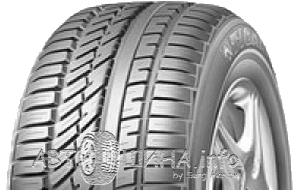
A summer tyre with asymmetric tread deserves special attention. Because one side is always (on any axle) the outer one, manufacturers manage to noticeably improve some of the tyre’s characteristics, almost without harming the others. The most obvious gain is the absence of the spare-wheel problem described above, which affects directional tyres.
But the advantages of asymmetric summer tread do not end there, of course. By making the tread blocks on the outer side denser and stiffer, manufacturers achieve a substantial improvement in directional stability (it is precisely the outer part of the tread that is responsible for the car’s stability in a corner). At the same time, the inner side of an asymmetric tyre’s tread is given wide water-clearing channels, which improves resistance to aquaplaning.
In general, an asymmetric summer tyre is essentially an improved classic one, since while improving certain important characteristics it remains universal and copes well in any conditions. The one drawback of such tyres, probably, is the price: not every motorist can afford them. It is worth noting, though, that for an ordinary motorist who keeps to (or tries to keep to) the traffic regulations, the improvements an asymmetric tyre offers over a classic one are not important enough to justify stretching your budget. If you can afford such tyres, by all means buy them; if not, do not worry: a classic tyre will most likely suit your car and how you use it perfectly well.