Can you use wheel spacers

What are wheel spacers usually for?
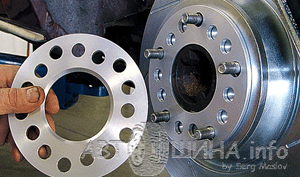
It often happens that wheels you really like simply are not made with the offset you need, even though they meet all the car maker’s other requirements (width, diameter, centre bore, the number and diameter of the circle the bolt holes sit on, that is, the PCD). Wheel spacers are offered as a way out of this, meant to reduce the wheel’s offset to the figure you need. In essence, wheel spacers are metal discs the shape of a pancake, fitted between the wheel and the hub.
Using wheel spacers this way is more or less justified (with the caveats below), but only on condition that the spacers reduce the wheel’s offset exactly to the standard figure (the one the car maker specifies), no more and no less. If, on the other hand, you are thinking of using spacers to improve your car’s looks (cosmetic modification), you would do better to first read the article on how a wheel’s offset affects driving safety and the technical condition of the suspension. Briefly: if your car and your life matter to you (no more and no less), it is better to steer clear of that kind of styling.
What kinds of wheel spacer are there?
There are two main types of wheel spacer: in some cases the spacer simply has through-holes drilled for the hub’s bolts (studs), in which case the bolts will most likely need to be replaced with longer ones (the length increases by exactly the thickness of the wheel spacer). As a rule, such spacers are no more than 10 mm thick. In other cases the spacer has holes drilled for the hub’s bolts, and separate threaded holes drilled for fitting the wheel. In this design the spacer bolts to the hub on its own, and the wheel, in turn, is bolted to the spacer. This version lets you change not just the offset but also the number of bolts and the PCD (the diameter the holes sit on). What’s more, spacers of this type usually have a spigot for centring the wheel, just like the one on the hub. So when choosing such spacers you need to pay particular attention to whether the wheel’s centre bore matches this parameter of the spacer.
Conditions for choosing and using wheel spacers
On the whole, from the point of view of mechanics, using spacers is only possible in cases where the wheel’s actual offset is greater than the offset it was designed for (the one the car maker needs), and the spacer’s thickness must exactly match the difference between the two offsets (remember, offset is measured in millimetres). But you need to understand that the quality of the spacer is what matters most here, because with even the smallest error in where the hole sits, or simply if the metal the spacer is made from is not uniform, the wheel will run out of true, wearing out your suspension at an accelerated rate and creating critical loads on the suspension in extreme conditions (which is already a risk of the running gear failing while the car is moving). So you must never, under any circumstances, use home-made wheel spacers, or ones from unknown manufacturers.