What is rubber hardness on the Shore scale?
Hardness and stiffness are different things, and greater hardness and stiffness are not always good or even needed for every condition. A motorist’s main task is to decide which functions (parameters) of a tyre matter most to them, and only then try to make the right choice of summer tyre.

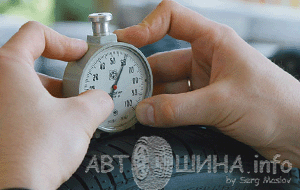
Every tyre maker has its own technology and its own recipes for the compounds tyre treads are made from, and any one maker most likely has several such recipes. Nobody, of course, will tell you the chemical composition or the recipe itself, but you can learn something about a tyre’s compound, for instance, from its rubber hardness on the Shore scale, or from how the maker positions the tyre on the market.
To simplify things as far as possible, there is a certain maximum and minimum hardness of rubber compound suitable for making tyres, and manufacturers vary their recipes within that range. Rubber hardness is measured with special instruments, Shore durometers, and expressed, accordingly, in Shore units.
The scale and method for determining the hardness of low-modulus materials (plastics, elastomers, rubbers and so on) were proposed by Albert F. Shore, hence the name. The principle behind the Shore method is fairly simple: a special indenter is pressed into a sample of the material with a set force and under set conditions. The depth of the indentation determines the material’s hardness (in inverse proportion: the deeper it goes, the softer the material). The rubber compound tyre treads are made from typically has a hardness in the range of 50-70 Shore units.
What do rubber hardness and compound affect?
Above all, the hardness of the rubber compound a tyre’s tread is made from determines the quality of its grip on the road surface: the softer the rubber (the lower the hardness), the better the grip, other things being equal. But there are significant side effects that stop manufacturers making tyres too soft and force them to design balanced tyres aimed at one set of conditions or another. Here are the main side effects:
Drawbacks of soft rubber (other things being equal):
- Soft rubber wears faster.
- Soft rubber holds its shape worse, which reduces directional stability and stability in corners and bends.
- Soft rubber is noisier.
- Soft rubber heats up more, and so has a lower speed rating.
Advantages of soft rubber (other things being equal):
- Shorter braking distance and better acceleration.
- Better grip on a wet road surface.
- Somewhat better handling, thanks to better grip on the road surface.
- More comfortable on a poor road surface.
It should be said straight away that rubber hardness is far from always declared by the manufacturer, and you can usually only find this figure for a specific tyre model from test results, and even then only if that model took part in a test. As a rule, hardness is tied to other parameters: for instance, so-called high-speed tyres are usually made from a harder rubber compound, and so-called rain tyres from a softer one.
All articles in this section: Choosing summer tyres