Speed rating, load index, and tyre season markings again
A tyre’s speed rating and load index are figures you must pay attention to when buying. The speed rating limits your maximum speed, and the load index shows the maximum weight of the car that can fall on one wheel.

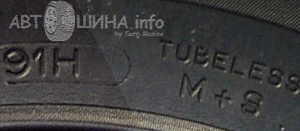
Right next to the tyre size on the sidewall you will usually find the load index (91 in the picture), the speed rating (H), the season marking (in some cases, M+S in the picture), and whether the tyre can be fitted on the wheel without an inner tube (TUBELESS).
Being able to fit the tyre without using an inner tube is shown by the word TUBELESS; if that word is not on the tyre, you need an inner tube.
Among the markings motorists usually associate with the season a tyre is meant for, there are two similar but different ones: “M+S” and a snowflake symbol. The snowflake is straightforward - that marking unambiguously points to a winter tyre. The situation with “M+S” is much more complicated. The letters stand for Mud and Snow,  but in practice this marking is printed on winter tyres, all-season tyres, and sometimes even on summer “off-road” tyres (the ones with chunky tread lugs). The rubber compound these tyres are made from can be very different, regardless of how similar their tread pattern looks. So, the M+S marking does not unambiguously mean a winter tyre - remember that when choosing winter tyres.
The speed rating shows the maximum safe speed at which the tyre can be used. You need to understand that, although tyre makers tend to build in a safety margin, given the state of many roads, you should absolutely not even approach the maximum figure printed on the tyre, let alone exceed it. Remember that a tyre failing (any tyre) at that speed can have consequences you cannot undo.
The load index shows the maximum share of the car’s weight that can fall on one wheel. There are two things to bear in mind here. First, the car’s weight is far from always evenly split between the front and rear axles, so when choosing a tyre’s load index you should build in a small margin above a quarter of the car’s full laden mass. Second, the higher the load index, the thicker the tyre’s carcass and the less give it has (its ability to cushion potholes and bumps), so too large a “safety margin” will make the car less comfortable to drive and speed up wear on the suspension. So the optimal load index is roughly 30-35% of the car’s full mass, but never lower than the index the car maker has specified for your car.
Table of load index and speed rating values for car tyres
| Load index | MAX mass, kg |
|---|---|
| 70 | 335 |
| 71 | 345 |
| 72 | 355 |
| 73 | 365 |
| 74 | 375 |
| 75 | 387 |
| 76 | 400 |
| 77 | 412 |
| 78 | 425 |
| 79 | 437 |
| 80 | 450 |
| 81 | 462 |
| 82 | 475 |
| 83 | 487 |
| Load index | MAX mass, kg |
|---|---|
| 84 | 500 |
| 85 | 515 |
| 86 | 530 |
| 87 | 545 |
| 88 | 560 |
| 89 | 580 |
| 90 | 600 |
| 91 | 615 |
| 92 | 630 |
| 93 | 650 |
| 94 | 670 |
| 95 | 690 |
| 96 | 710 |
| 97 | 730 |
| Load index | MAX mass, kg |
|---|---|
| 98 | 750 |
| 99 | 775 |
| 100 | 800 |
| 101 | 825 |
| 102 | 850 |
| 103 | 875 |
| 104 | 900 |
| 105 | 925 |
| 106 | 950 |
| 107 | 975 |
| 108 | 1000 |
| 109 | 1030 |
| 110 | 1060 |
| 111 | 1090 |
| Speed rating | Maximum permitted speed, km/h |
|---|---|
| L | 120 |
| M | 130 |
| N | 140 |
| P | 150 |
| Q | 160 |
| R | 170 |
| S | 180 |
| T | 190 |
| U | 200 |
| H | 210 |
| V | 240 |
| W | 270 |
| Y | 300 |
| Z (ZR) | >240 |