Does an electric car need “special” tyres?
A new label has appeared in tyre shops, “for electric cars” or simply “EV”, and, as usual, a new price to go with it. EV owners argue about whether ordinary tyres will do, on a Tesla and a modest city hatchback alike, while the salesmen, naturally, advise against taking a risk.

The sales assistant at a tyre fitter’s, seeing what you have arrived in, will invariably offer you the “electric” model, and when asked what makes it better, will answer roughly like this: “Well, it’s an electric car!” An ironclad argument, you must admit.
First, the main point: you can fit an electric car with ordinary tyres of the size the car maker has approved, provided their load index and speed rating are not lower than the ones it specifies. There are no separate legal requirements for “electric” tyres, and the tyre makers themselves say their ordinary models suit electric cars perfectly well. But this “not lower” is nothing to joke about.
What makes an electric car harder on its tyres?
First, weight. Because of the battery, an electric car is usually 300-500 kg heavier than its petrol-engined “classmate”, and sometimes more, that is, roughly a quarter heavier. Second, torque: an electric motor delivers all of it at once, from a standstill, straight into the small contact patch of the driven wheels. Third, silence: the engine no longer drowns out the tyres, and in the cabin it is precisely them you hear. And fourth, range: part of the battery’s energy goes on rolling resistance.
So the tyre does not know there is a battery in the car: it knows only the weight, the torque and the pressure. This applies to heavy hybrids and large crossovers as well: the tyre does not care where the extra kilograms came from.
XL, HL and the load index
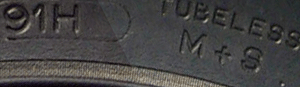
The load index is the number after the tyre size which, read off a table, gives the maximum load per wheel. A reinforced tyre is marked XL (Extra Load) at the end of the marking, after the ratings. And in 2021 the European Tyre and Rim Technical Organisation (ETRTO) introduced one more class, HL (High Load), precisely with heavy electric cars and hybrids in mind; the HL mark goes before the size. An example for size 245/40 R19: a standard tyre has index 94 (670 kg), an XL has 98 (750 kg), an HL has 101 (825 kg). So an HL carries roughly a tenth more than an XL (at the same pressure) and almost a quarter more than the maximum load of a standard tyre of this size.
Hence a rule that is not up for discussion: the load index of a new tyre must not be lower than the car maker specified, and if XL tyres were fitted at the factory, you may replace them with XL or HL, but if HL, only with HL. Look for these figures on the plate on the driver’s door pillar (on some cars, on the glovebox lid) and in the owner’s manual. An ordinary tyre “in the right size” on a car that needs HL does not solve the problem: it merely hides it until the first pothole. On top of that, the law is on the same side: EU roadworthiness tests count a tyre whose size or load capacity does not meet the requirements as a defect, and Ukraine’s traffic regulations (clause 31.4.5 (c)), for example, prohibit operating a car if “the tyres do not correspond to the vehicle model in size or permissible load”. The Ukrainian regulations do not mention the speed rating, but it too must be no lower than the factory one (the exception is winter tyres, but then do not drive faster than their rating allows), and chasing a higher one usually makes no sense (about speed-rated tyres).
So do not count “by eye” from the weight of the car: the car maker’s plate decides. Headroom above the factory value is allowed, going below it is not, and there are no compromises here, and there cannot be. I will be honest: over potholes an XL tyre is a little stiffer, and on broken roads you feel it at once. But comfort is a matter of taste, while load capacity is a matter of safety.
And one more subtlety: XL and HL “earn” their index only at a higher reference pressure, 2.9 bar against 2.5 bar for a standard tyre. So take the pressure from the car maker’s plate for your size and tyre variant, not “the way we always pumped them up” (more about tyre pressure). On a heavy car pressure sensors are certainly not superfluous.
Why do tyres wear faster on an electric car?
One of the largest tyre makers admits itself that on electric cars tyres wear up to 20% faster than on petrol and diesel cars. And independent measurements show that an extra 450 kg of weight means roughly a fifth more wear. Add the instant torque, and the driven wheels wear down faster still, especially for drivers who like to “shoot” away from the traffic lights.
So will an ordinary tyre “burn up” on a heavy car within a season, as they try to scare you on car forums? Far from always: on cars designed as electric from the start, the same maker calls the wear comparable to that of an ordinary car. And will a “special” tyre help? To a degree: compounds are made for electric cars that are meant to last longer, but you cannot cheat physics: softer rubber grips the road better and wears faster (about rubber hardness).
It is like shoes: whoever walks calmly wears boots for years, and whoever keeps breaking into a run wears out the soles in a season. So the cheapest “electric car tyre” is a smooth right foot. The rest is correct pressure, timely wheel alignment and regularly swapping the wheels between the axles.
Foam inside and “quiet” tyres
In the silence of an electric car you can clearly hear a low “hum”. What hums, strictly speaking, is the air resonating in the closed cavity of the wheel. Against this, makers glue a layer of polyurethane foam on the inside, under the tread. One of them promises to dampen this hum by as much as 9 decibels: the hum itself, not all the noise in the cabin, and even then depending on the car, the speed and the road. Tesla often fits such tyres at the factory to the Model 3 and Model Y; for their factory sizes and the sidewall markings, see the article on Tesla tyres.
Such tyres are mostly more expensive, and repairing a puncture in them is a story of its own: to fit a patch, the fitter first has to cut out a piece of foam around the damage, and far from every tyre fitter can do it (about puncture repair).
The second really useful property of “electric” tyres is lower rolling resistance: compared with an ordinary tyre it adds range, 5-7% in many comparisons, but it all depends on the car and the tyre itself. The rolling resistance class can be seen on the European label of an ordinary tyre too, not only of one marked “for electric cars”. And if your crossover also runs R19-R20 wheels, there is a separate conversation about those.
To sum up: you can fit an electric car with any good tyres of the right size, provided the load index and speed rating are not lower than the car maker specified, and the XL or HL mark is the same or higher. Foam, lower rolling resistance and a longer-lasting compound are useful things, but they are a matter of comfort and money, not of safety: whether to pay for them is up to you. The main thing is not to pay for the sticker alone.
All the articles in this section: Choosing tyres
Question and answer
- Can you fit ordinary tyres to an electric car such as a Tesla?
- You can, provided the size is one the car maker has approved and the load index and speed rating are not lower than the ones it specifies. XL tyres fitted at the factory are replaced with XL or HL, and HL only with HL. A “for electric cars” sticker is not required for safety.
 Speed rating, load index, and tyre season markings againA tyre’s speed rating and load index are figures you must pay attention to when buying. The speed rating limits your maximum speed, and the load index shows the maximum weight of the car that can…
What is rubber hardness on the Shore scale?Hardness and stiffness are different things, and greater hardness and stiffness are not always good or even needed for every condition.
High-speed tyres: what are they and who needs them?Having high-speed tyres is often a matter of pride and desire for young motorists who prefer an aggressive driving style.
Tyre pressure sensors: a helper or a new expense?Fifteen years ago in Europe a tyre pressure monitoring system was a privilege of expensive cars, and today the yellow “horseshoe” with an exclamation mark lights up on the dashboards of many drivers…
Speed rating, load index, and tyre season markings againA tyre’s speed rating and load index are figures you must pay attention to when buying. The speed rating limits your maximum speed, and the load index shows the maximum weight of the car that can…
What is rubber hardness on the Shore scale?Hardness and stiffness are different things, and greater hardness and stiffness are not always good or even needed for every condition.
High-speed tyres: what are they and who needs them?Having high-speed tyres is often a matter of pride and desire for young motorists who prefer an aggressive driving style.
Tyre pressure sensors: a helper or a new expense?Fifteen years ago in Europe a tyre pressure monitoring system was a privilege of expensive cars, and today the yellow “horseshoe” with an exclamation mark lights up on the dashboards of many drivers…
 Tyre pressureWhat is the right tyre pressure? What the car maker recommends, where to find the pressure label, and when to adjust it slightly for your roads.