How does a winter tyre differ from a summer one?
Most drivers think winter and summer tyres differ mainly in tread pattern. In fact, the key difference is how the rubber handles temperature.

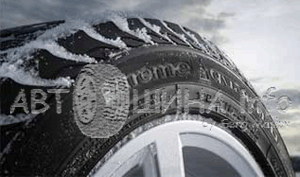
It is commonly assumed that the main difference between winter and summer tyres is just the tread pattern. In truth that is not the case at all. That is to say, yes, in the vast majority of cases the pattern really is different, but that is far from the main, defining difference.
Have you ever, as a child, held an ordinary rubber (eraser) out in the frost? Do you remember what happens to it? Once the rubber has frozen through, you can snap it without any difficulty, literally, because in that state it no longer bends, and, naturally, it will not erase anything either, until it warms up. Why is that? Because rubber, like all other materials, changes its properties substantially depending on temperature.
That is why tyre manufacturers develop a different chemical composition of rubber for different temperature ranges, in effect “tuning” a particular tyre for use within a particular temperature range. Almost nobody publishes that range, but the following is a standard rule for everyone:
- Winter tyres are not recommended for use above +5 degrees Celsius. Not only do they become softer and literally “melt”, they also stop performing their functions fully, and the car’s stability on the road becomes a serious question.
- Correspondingly, a summer tyre, as the air temperature approaches “zero”, hardens and becomes completely “wooden”, which substantially increases the likelihood of a skid (even on a relatively dry surface), as well as the likelihood of the tyre bursting from an ordinary puncture.
- All-season tyres feel best precisely around zero temperatures, say, from -5 to +10 degrees Celsius.
Question and answer
- How do winter tyres differ from summer ones?
- A summer tyre differs from a winter one not only in tread pattern but also in rubber compound. Winter tyres lose their hardness and “melt” at air temperatures above 5 degrees Celsius, while summer tyres “go hard” and lose grip on the road at zero degrees.