Wheel offset (ET)
Motorists often either pay no attention to offset as a parameter, or sometimes deliberately ignore it when choosing wheels. This article is written specially for them: what offset affects, and why you should not fit your car with wheels whose offset the manufacturer never specified.

Wheel offset: everything you need to know
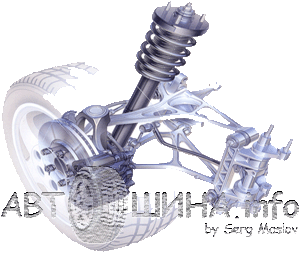
Wheel offset is, in fact, one of the most important of its geometric parameters. The reason it matters so much is this: if a wheel does not match in diameter, number of bolt holes or the spacing between them, you will most likely simply be unable to fit it onto the hub at all, whereas a wheel with the wrong offset (if the deviation is small) will usually sit on the hub without any trouble and seem to do its job normally. How far can you trust that “seem”?
On various car forums motorists often argue about “how far, and in which direction, a wheel’s offset may differ from standard”, and the opinions expressed are often diametrically opposed.
A sales assistant at a specialist tyre shop will most likely tell you that a small deviation from the car maker’s offset requirements is perfectly acceptable, and that if the complete wheel sits properly on the hub and does not foul the suspension or the bodywork as it turns, such a wheel can definitely be fitted to the car. A seller of wheel spacers, for his part, will tell you that reducing a wheel’s offset is no problem at all, whatever the exact figures. And that is understandable: his goal is to sell you wheels, wheel spacers and other goods. Your goal is to buy exactly what suits your car.
So what is the truth? Let’s work through all of it in order, and without rushing.
Articles in this sectionIn reading order.
- Wheel offsetWhat is wheel offset (ET)? The formula, positive, zero and negative offset, and what this wheel parameter affects.258 words
- Are deviations in wheel offset acceptable?Is a deviation in wheel offset acceptable? Why even a “minor” 5 mm changes how the suspension works, and why sellers claim the opposite.170 words
- Why do different trims of the same car use different parts?Why one car model with different engines has different suspension parts, and how precise calculations limit “garage” modifications.226 words
- What forces act on suspension parts?What forces act on suspension parts: taking a MacPherson strut as the example, how wheel offset changes the load on the hub and the arms.317 words
- What happens when the offset a wheel was designed for changes?What happens when wheel offset changes: how shifting the wheel’s axis affects handling, tyre wear and the load on the suspension.303 words