Wheel markings
Wheel markings: what a stamp such as 6.5J x 15 5/112 H2 ET45 d 57.1 means, and why these parameters matter for safety.

What information is stamped on a wheel
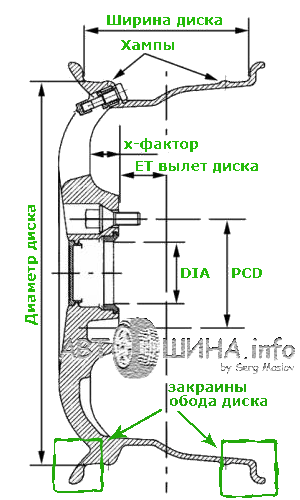
In fact, any wheel has rather more parameters than the diameter and the number of bolt holes, which is mostly all motorists pay attention to. And most of these parameters are just as critical for safe driving and for keeping the car’s suspension intact. So when choosing wheels you first need to find out which of the parameters listed below your car’s manufacturer allows, as acceptable, and then look for wheels that fully match the figures you need.
It is important to understand that any deviation from the car maker’s technical requirements for wheels and tyres directly affects how the suspension works, and creates a risk not just of accelerated wear to the tyre and/or the running gear, but of their sudden failure in extreme conditions. If the engine cuts out on the road, that is unpleasant but solvable: you can call a taxi, a mechanic or a recovery truck, and so on. But if a wheel comes off at high speed, that is a real threat to life, and often not just one or two lives. So the car’s suspension, and everything connected with it (wheels included), must always fully meet the car maker’s requirements and stay under the driver’s constant watch.
So what is stamped on a wheel? The main markings on a wheel usually look something like this:
6.5J x 15 5/112 H2 ET45 d 57.1
Let’s try to decode this gibberish.
6.5: the rim width, given in inches. In this case the rim width works out at 6.5 x 25.4 = 165.1 mm. It is worth noting that this parameter is directly tied to the tyre’s width. For every tyre width there is a range (from and to) of wheel widths the tyre can be fitted to. The best option is for the wheel width to sit somewhere near the middle of the range allowed for that tyre. You can find the permitted wheel width for a particular tyre using the tyre size calculator on this site: you just need to pick the tyre size. Bear in mind that if the wheel width does not match the tyre’s width, this will most likely cause a problem fitting the tyre onto the wheel, and will also noticeably worsen the tyre’s performance, so this is a parameter you must always pay attention to.
J (JJ, JK, K, B, P, D …) This letter encodes technical information about the wheel’s rim flanges (their construction, shape and height). The most common types of wheel today are J (mostly for two-wheel-drive cars) and JJ (usually for four-wheel drive). The wheel’s rim flanges affect how the tyre and the balance weights are fitted, as well as how resistant the tyre is to shifting on the wheel in extreme conditions. Obviously, despite J and JJ wheels being outwardly interchangeable, for example, it is still better to choose the parameter your car’s manufacturer recommends.
5/112: the parameters for fitting the wheel to the hub
5: the number of bolt holes on the wheel;
112: the diameter, in millimetres, of the circle on which these holes sit (more precisely, their centres). Sometimes this figure is stamped on the wheel separately and marked PCD (Pitch Circle Diameter).
It is very important not to get this wrong, because there are a great many different standards for this figure, and the difference between neighbouring ones is sometimes only a few millimetres, so, say, a wheel from a Jaguar (PCD 120.65) will visually sit perfectly on a BMW hub (PCD 120), but that does not mean it can be used on that car. In the same way, Lada 4/98 wheels slip onto the hubs of many imported cars specified for the 4/100 size.
The main thing to understand here is that despite the noticeable difference between the diameter of the wheel’s bolt holes and the bolts (studs) themselves, the car maker calculates the fit of the wheel on the hub very precisely. This is because even the smallest deviation between the centre of the hub and the centre of the wheel will not just cause the wheel to run out of true (usually accompanied by vibration through the steering wheel), but will also put the reliability of the wheel’s fitting at risk, because if the diameter on which the bolt holes sit does not match the hub’s figures, it becomes impossible to fully tighten all the tapered-seat wheel bolts (or nuts), which are meant to centre the wheel on the hub. And that is a threat not just to your wallet, but to your life.
H (H2, FH, AH, CH…) these letters encode information about the design of the wheel’s bead seats and the humps on them. Humps are meant for tubeless tyres and help the tyre seat correctly on the wheel. Some tyres (run-flat tyres, for example) call for particular wheel parameters here, and this is worth checking when buying tyres. On the whole, a motorist does not need to dig deeply into the meaning of these markings.
ET45 the wheel’s offset (mm). The distance between the wheel’s mounting face against the hub and the wheel’s central axis. This figure must exactly match the car maker’s requirements, because the key parameters of the suspension and the steering mechanism are calculated around it. A wheel’s offset depends neither on the wheel’s diameter, nor on the tyre’s width, 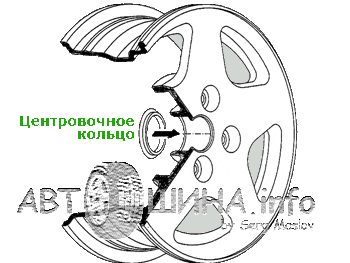 nor on any of its other parameters. For each wheel size the car maker provides for, it is a specific figure, not a range. Alternative markings (depending on the country of manufacture): OFFSET, DEPORT. More on wheel offset.
d 57.1 (DIA) the diameter of the wheel’s centre bore. It must exactly match the diameter of the hub’s spigot. Bear in mind that besides its centring role, the hub’s spigot has another job that matters just as much: it takes part of the load that would otherwise fall on the wheel bolts (studs). So if the centre bore of a wheel you like is bigger than the hub’s spigot, you will have to use special spigot rings, which you can buy at a tyre centre, or have made to order by some home mechanic. It is, of course, better to buy ready-made ones: they are more reliable. But even so, the outer and inner dimensions of the spigot ring must exactly (!) match the diameter of the hub’s spigot and the wheel’s centre bore, respectively. There is no room here for a gap of 1 mm or even a couple of millimetres: it would defeat the whole point of fitting these rings.