Summer tyre section width: wider or narrower?
Every spring, car forums break countless lances over the choice of summer tyre section width. In truth, there is no single right answer for everyone: you need to choose the width that best suits your driving conditions and style.

The liveliest arguments usually break out on popular car forums over the width of summer tyres: some motorists insist that wider is always better, while others prefer tyres of medium section width. As always, the truth is somewhere in between: the optimal width is different for different driving conditions. But let’s take it in order.
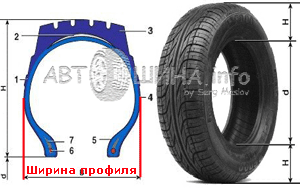
What is a tyre’s section width? Section width is the distance between the sidewalls of a tyre inflated to its rated pressure (this measurement disregards raised features on the sidewall such as markings, trim and so on). Section width does not always match tread width, but for one model of tyre a direct relationship always holds: the wider the section, the wider the tread.
For safety reasons, the wheel’s rim width must be within the range permitted for that tyre, which the tyre standards set for each tyre size (bearing in mind that wheel width is usually given in inches and section width in mm, the simplest way to check whether a particular tyre fits a particular wheel is to use the tyre size calculator on this site).
What does a tyre’s section width affect?
Above all, section width (for a given tyre model) determines tread width and, as a result, the area of the tyre’s contact patch with the road surface. That characteristic, in turn, directly affects handling, directional stability, braking distance, fuel consumption and resistance to aquaplaning.
Among the benefits of a wide tyre are better acceleration and braking figures, better directional stability (the car holds the road better in a corner at high speed), and somewhat better off-road ability. And, of course, the looks: a wide tyre always makes a car look more substantial.
Among the main drawbacks of wide tyres are reduced resistance to aquaplaning, higher fuel consumption, and higher weight (which increases the load on the suspension) and a higher price.
If you weigh up the advantages and drawbacks, you can draw roughly the following conclusions:
1. If you drive mostly in town for most of the season and are not keen on extreme driving, and if your car has a small engine (up to 2,000 cc), then a narrow tyre is definitely the rational choice for you: in town you will not notice the advantages of a wide tyre at all, while the drawbacks will hit your family budget hard. That said, when you do get onto the motorway, you should take some care entering sharp corners at speed. Simply keeping to the traffic regulations will be more than enough, though.
2. If you often drive on the motorway and like to “put your foot down”, and if your engine’s power allows it, then your choice is a wide tyre, but you will need to take particular care in the rain and on a wet road: a wide tyre will behave worse than its narrower sister when it hits a puddle.
Have you noticed that there is not a single figure in the recommendations above? That is because you should start choosing your tyres’ section width by checking your car’s owner’s handbook, which lists all the permitted tyre sizes for your car (the same list is also on the tyre pressure table stuck to the fuel filler flap or inside the driver’s door opening). The maximum section width of those listed is then your “wide tyre”, and the minimum, accordingly, your “narrow” one.
Fitting your car with tyres of a section width the car maker did not intend is extremely dangerous, even where doing so does not require wheel spacers: do not play with fire, tyres are your safety (and often your life).
All articles in this section: Choosing summer tyres