Tesla Model 3 and Model Y tyres: sizes, pressure, T0
Tesla owners hunt for the “right” tyres as keenly as for a vacant charging point, and sales assistants are happy to hint that “ordinary” tyres will not do for an EV.

A sales assistant at a tyre centre, spotting the familiar logo on the bonnet, will usually lower his voice at once: “For a Tesla it has to be T0, or the car won’t drive ‘right’.” Car forums answer him with the opposite: “I fit whatever I like, it’s just a car.” In truth, each of them is half right.
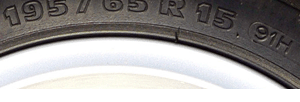
The main thing first: you can fit any good tyres of the right size on a Tesla, provided their load index, speed rating and XL marking are not lower than the factory ones. The T0 mark on the sidewall is not a legal requirement but a sign that Tesla itself tested and approved that tyre. Still, these cars have a few quirks that the sales assistant either does not know about or keeps quiet about.
What tyres does a Tesla leave the factory with?
According to the European owner’s manual for the current Model 3, it is 235/45 R18 or 235/40 R19 on all four wheels, while the Performance version on 20-inch wheels has a different size on each axle: 235/35 R20 at the front and 275/30 R20 at the rear (Model 3 cars built in 2017-2023 had the same 20-inch tyres all round, 235/35 R20). For the Model Y, according to the manual for cars from 2025, it is 235/55 R18, 255/45 R19 or 255/40 R20 all round, and the Performance on 21-inch wheels is staggered again: 255/35 R21 at the front and 275/35 R21 at the rear (as on the 21-inch wheels of the 2020-2024 Model Y). The current Model S and Model X have wider rear tyres on all factory wheels.
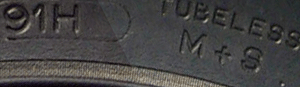
Now for load. For the Model Y the manual requires at least 104 XL on 18- and 19-inch wheels (900 kg per wheel), 101 XL or 104 XL on 20-inch ones, and on the Performance 98 XL at the front and 103 XL at the rear. So a tyre “in the right size” but without XL and with a lower load index must not be fitted to a Model Y. On other Teslas the rule is the same: a load index no lower than the factory one. A factory XL tyre is replaced with XL or the even stronger HL, never with a standard-load tyre. I explain why in detail in the article on tyres for electric cars, and the load index table is here.
Tesla’s figures differ by market and model year, and a good many used Teslas in Eastern Europe are imported from the US, where both the label and the manual are different. So the final word always belongs to the tyre label on the centre door pillar, which you can see when the driver’s door is open.
How do you rotate the wheels if the tyres differ between axles?
Wider rear tyres look good and help acceleration, but they make tyre rotation awkward: you cannot swap them front to back because the sizes differ. In that case Tesla allows only side-to-side swaps, and only if the tread pattern is not directional. It is clear about the interval: every 10,000 km, or sooner if the difference in tread depth between the tyres has reached 1.5 mm since the last rotation.
So on a car with a “staggered” set the front and rear pairs live separate lives, and you will most likely have to replace them at different times. When buying a used Tesla Performance, look not only at the mileage but also at how much tread is left on each axle.
What do T0 and T1 on the sidewall mean?
Tesla explains this itself: the letter “T” marks the tyres it has approved; T0 is the first approved version, and T1, T2 and so on are the later ones, with new tuning or technology. Each such tyre is developed together with the tyre maker, balancing noise, ride comfort, handling and rolling resistance for a specific car. Tesla itself promises that a new generation of its approved tyres adds up to 34 km of range (on the WLTP cycle), though that is compared with earlier versions of the tyres, and the example it gives is an early Model S. A convenient comparison, you’ll agree.
But here is what its own manual says: if you fit other tyres, make sure their load index and speed rating are no lower than the original ones. Not a word about a mandatory letter T. So T0 is a matter of quiet and range, not of safety, and which matters more to you is for you to decide. One thing, though: the tyres on an axle must be identical, and if you have to replace a single tyre (say, after a puncture that cannot be repaired), Tesla advises replacing the pair, unless the others are worn by no more than 1.5 mm compared with a new tyre.
What do you do about a puncture if there is no spare wheel?
Many Tesla tyres are lined on the inside with acoustic foam: by Tesla’s own measurements on the Model X, the foam cuts the peak road hum at about 200 Hz by 6 decibels. Can such a tyre be repaired? Yes. The US tyre manufacturers’ association (USTMA) puts it simply in a service bulletin: the tyre is taken off the wheel, the foam around the puncture is carefully cut away, the tyre is repaired in the usual way (the puncture channel is filled and a patch is applied on the inside), and the cut-out foam is not glued back in, because there is no need. The remaining rules are the same as for any puncture. If a tyre fitter refuses because “there is some sort of sponge in there”, find another one.
Teslas leave the factory without a spare wheel: neither a full-size one nor a space-saver. The European manual for the Model 3 calls the tyre repair kit (a compressor and sealant) an option that is bought separately, and warns honestly that it is only for punctures of up to 6 mm in the tread: with a damaged sidewall or a tyre that has come off the rim, go straight to roadside assistance. A third-party sealant, according to the same manual, can damage the pressure sensor inside the wheel. What to carry instead of a spare is a subject of its own.
And then there is the jack. A Tesla may be lifted only at the designated jacking points, never under the battery or the side sills. Damage from incorrect lifting is not covered by the warranty, and I don’t think I need to tell you what a battery costs. On top of that, the manual forbids lifting the car with the charging cable connected, even if it is not charging. Tell the fitter all this before he positions the lift “wherever is handy”.
What pressure should you run, and what happens to the sensors in winter?
The recommended “cold” pressure is printed on that same label on the pillar, and the car’s screen shows it too. Tesla gives 40-45 psi depending on the version, which is roughly 2.8-3.1 bar. Measure on cold tyres, after the car has stood for more than three hours: a kilometre and a half of driving is enough to change the pressure. And it drops as the temperature falls: Tesla reckons on about 1 psi for every 6 °C (more about tyre pressure).
Depending on the version, a Tesla’s tyre pressure monitoring (TPMS) is either direct (a sensor in each wheel) or indirect. With the direct system, after a wheel change the sensors “introduce themselves” to the car after a few minutes of driving above 25 km/h (the manuals of different models give anything from two to ten minutes). But the sensors come in different generations (newer ones work over Bluetooth), so your car may simply not see a winter set fitted with the wrong sensors: check this before you buy. The indirect system needs a manual calibration in the menu after a wheel change, followed by at least 20 minutes of driving above 25 km/h (how pressure sensors work). And select winter tyres in the menu: on soft winter rubber the car may temporarily reduce regenerative braking until it has relearned, and this setting speeds that up.
Winter tyres go on only as a set of four identical tyres with the mountain-and-snowflake symbol; Tesla also says that with less than 4 mm of tread a tyre no longer works properly in snow and slush. Snow chains: rear wheels only, only chains approved for your tyre size, never on summer tyres and never above 48 km/h; take the decorative wheel covers off first. As for what the law requires, see the article on winter tyres and the law.
To sum up: a Tesla does not need “magic” tyres, but it does need the right ones: the size and load index from the placard, XL where it was fitted at the factory, and the pressure the car maker states. The T0 mark means quiet and a few kilometres of range, and whether to pay for them is up to you. But chains on the front wheels, a jack under the battery and “I pump them up the way I always have” are no longer a matter of taste.
All the articles in this section: Choosing tyres
Question and answer
- Do you have to fit tyres marked T0 on a Tesla?
- No. T0 or T1 only means that Tesla approved the tyre. Its manual asks just for the size on the door-pillar label and a load index and speed rating no lower than the factory ones; a factory XL tyre is replaced with XL or HL. The T mark buys quiet and range, not safety.
 Tyre pressureWhat is the right tyre pressure? What the car maker recommends, where to find the pressure label, and when to adjust it slightly for your roads.
 Speed rating, load index, and tyre season markings againA tyre’s speed rating and load index are figures you must pay attention to when buying. The speed rating limits your maximum speed, and the load index shows the maximum weight of the car that can…