What is aquaplaning?
Tyre makers and sellers never stop frightening motorists with every means available with that scary word - aquaplaning. And in the fight to save you from it, they will not spare a penny.

Can tyres help you avoid aquaplaning on the road?
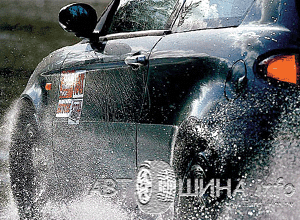
The phenomenon of aquaplaning itself was studied in detail in aviation back in the 1960s, but in the tyre business the term became a buzzword at roughly the same time as directional rain tyres were invented, and used in that sense it can safely be filed under marketing. A scare story of sorts to nudge motorists into buying more expensive tyres. Although this characteristic (resistance to aquaplaning) does have some meaning for the consumer, even if not as much as tyre makers and sellers try to make out.
So, aquaplaning is a complete loss of contact between the tyre and the road surface, caused by a wedge of water forming between the road and the wheel. The result of aquaplaning is a complete or partial, temporary loss of control of the car. Obviously, this can only happen on a road that has water on it (for example, in heavy rain and/or a large puddle), and its consequences depend directly on your current speed, the specific situation on the road, and the driver’s ability to keep a cool head in an extreme situation.
In essence, aquaplaning is a very short-lived phenomenon and can last a fraction of a second, but, unfortunately, that is sometimes enough time for serious trouble on the road. Under the laws of physics, the moment at which a tyre completely loses contact with the road (and whether it happens at all) depends directly on the mass of the car bearing down on the wheel, the speed of travel, and the thickness of the water film on the road. And speed is the main factor here! It is speed that determines the force pushing the car up onto the surface of the water.
And to some extent that moment also depends on how effectively the tyre clears water from the contact patch. This factor is not decisive, but it is not trivial either: it depends first of all on the remaining tread depth, and much less on the “rain” tread pattern. It is also worth understanding that a complete loss of control requires aquaplaning to happen at the same time on at least two wheels on one axle, and it is far worse if that axle is the front one.
How can you avoid aquaplaning?
Given the factors that determine when aquaplaning happens, the main way to avoid losing control is simply to keep to the traffic regulations and to slow down in rain and on a wet road. Whatever tyre you have fitted, however good and resistant to aquaplaning it is, that should not relax you in the slightest - caution on the road is what matters most.
Even experienced drivers quite often fall victim to aquaplaning, trying to apply skid-avoidance tactics that are meant for regular skidding. Here you need to understand that there is a huge difference between aquaplaning and skidding, both in terms of physics and in terms of how the car behaves. So do not confuse aquaplaning, which only happens at high speed, with skidding on a wet road (which usually happens right at the start of rain).
If you feel the car “floating” and you can no longer control its path, do not make any sudden movements whatsoever, either with your hands (the steering wheel) or your feet (the pedals). Simply lift off the accelerator, and control will come back, at least partially, very soon, after which you can carefully carry on driving according to the situation. Under no circumstances should you stamp on the accelerator or the brake, or wrench the steering wheel, in that situation - an uncontrolled skid is almost guaranteed.
But above all, remember that it is far easier, and far wiser, simply not to let such a situation happen than to get out of it in one piece.
Is there any point in rain tyres?
At some point tyre makers took up the fight against aquaplaning and started producing specialised rain tyres, usually with a directional tread pattern designed to clear water from the tyre’s contact patch more effectively. Such tyres also look smarter on a car than classic ones, and cost correspondingly more. Are rain tyres a cure-all?
Clearly, if a tyre is properly engineered, with the necessary calculations and testing behind it, its tread pattern really will clear more water from the contact patch in a given time. But that only applies to quality tyres from leading makers. If, for the same money, you can buy a Chinese-made rain tyre from the world-famous maker “Noname”, or a classic tyre from a reputable brand, the classic tyre is definitely the better choice. It is entirely possible that a good classic tyre will actually resist aquaplaning better.
But, in general, when it comes to choosing tyres, there are a few important points worth understanding about resistance to aquaplaning:
1. No tyre guarantees that aquaplaning will absolutely never happen. Any tyre (even a non-directional classic one) should, and does, clear water from the contact patch, it is just that some tyres do it better than others. So for any tyre there is a critical combination of water film thickness on the road, car mass and speed at which it will, in any case, lose contact with the road.
2. The difference in when aquaplaning sets in between a classic tyre and a rain tyre of roughly the same quality amounts to no more than a few kilometres an hour, most likely not even tens of them, so buying a rain tyre should not change your driving behaviour in any way.
3. The very shape of a rain tyre’s tread pattern means that, all else being equal, a rain tyre will be noisier than a classic one; on top of that, a directional tread also wears somewhat faster than a classic one.
To sum up: on the whole, a good rain tyre definitely behaves better when it hits a layer of water at high speed - that is a fact. But having such tyres can loosely be compared with having airbags in the car - good to have them, but let us hope you never need them. That said, there is no need to give in to hysteria or panic - you can drive safely on a classic tyre for a long time, you just always need to stick to the basic rules of road safety. No tyre will save a fool, however cutting-edge or expensive it is.