A cut in the sidewall: repair or scrap?
Sadly, any damage to the sidewall of a radial tyre is, in all likelihood, already the end of its service life. Even so, many tyre fitters take on the repair of sidewall cuts in car tyres.

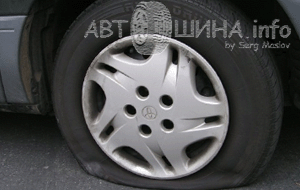
Many tyre centres offer (and spell out in a separate line of their advertising) sidewall cut repair. In doing so, they make a particular point of the fact that repairing a sidewall cut is an extremely serious, highly technical business, and that is why we (that is, they, the ones doing the advertising) employ top-class professionals and use materials from world-famous makers.
Motorists are fed this nonsense by the tonne, and the moment they find a cut in a sidewall they run themselves ragged looking for a fitter who will agree to cure it. And then they go and write reviews on the car forums: “what a good tyre fitter, everyone else refused, but they did it.” But how they did it, and whether you can actually drive on it afterwards, is something nobody usually stops to think about. Until, by some “strange coincidence”, two months later the wheel bearing has to be replaced three times, and, oddly enough, it is always the wheel with the successfully repaired sidewall cut. As for more serious consequences, it is better not to even talk about them.
For the lazy and the busy: this article unpacks and explains one simple truth: a sidewall cut in a radial tyre unambiguously means the end of its service life, regardless of the shape, size or configuration of the cut, however many Nobel prizes, medals and framed certificates the fitter has, and regardless of the alignment of the stars, the weather outside, and other far-from-trivial factors that directly affect whether a tyre with a damaged structure can still be used. And there are no compromises here at all: not on the front axle, not on the rear, and not on the driven or the non-driven axle either, such tyres must not be used!
How is a radial tyre built?
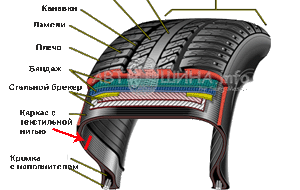
More detail on what’s inside a tyre is in the article on cross-ply and radial tyres, but in the context of why a sidewall cut is fatal, what interests us here above all is the tyre’s carcass. In a radial tyre, the carcass is several layers of rubber with a metal or textile thread embedded in them. It is this thread (the cord) that determines the tyre’s stiffness, the stability of the contact patch with the road, how well the inflated wheel keeps its shape, and, as a result of all of that, the car’s stability on the road.
The main feature of a radial tyre (and what distinguishes it from a cross-ply) is that in every layer of the carcass, the cord runs strictly perpendicular to the circumference of the wheel, from rim to rim. This arrangement of the threads also determines how the load is distributed at every point on the cord. If you think that the only thing pressing on the cord in the sidewall area is the air pumped into the tyre under pressure, you are very much mistaken. In reality, at every point on the cord, at any given moment, a multitude of different forces act with different vectors.
Every thread of the cord is, in effect, an independent carrier of the tyre’s shape and stiffness, because along its whole length it never crosses another thread (this is about the tyre’s sidewalls; things are simpler up top, where there is a belt and a tread): all the threads in a radial tyre run parallel. And this is exactly where the main problem of a radial tyre lies: once the cord is damaged on the tyre’s side surface, it is simply impossible to fully restore the necessary stiffness at that spot. So, however well a sidewall cut is repaired, that tyre will, in any case, always have different characteristics at that spot than at any other point on the circumference.
Of course, for gentle driving on a good (that is, smooth) road, and even in a 950 kg Lada, this is not all that frightening, but any extreme move by the driver (hard braking, taking a corner at speed, and so on) can already spring an extremely unpleasant surprise.
It’s a different story with a cross-ply tyre: there, the cord in the different layers of the carcass runs at an angle and overlaps, so damage to a few threads in one spot has practically no effect on its ability to keep its shape or on the load distribution at any point on the tyre. That is why the sidewalls of cross-ply tyres are considered entirely repairable. Admittedly, that is one of the few advantages a cross-ply tyre has over a radial one, which is why cross-ply tyres for passenger cars have long been a thing of the past.
How are sidewall cuts repaired?
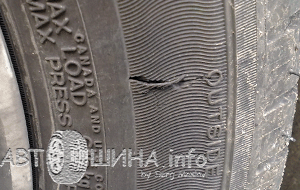
As a rule, the technology for repairing sidewall cuts involves two stages: vulcanising the cut itself, and fitting a special patch to the inside surface of the tyre over the cut, with a structure similar to the tyre’s carcass (cord). It has to be understood that this achieves only one goal: it restores the sidewall’s stiffness against “bulging” outward, and even then only to prevent a bulge from forming. It is from exactly this angle that the fitters at some tyre centres assess how large a sidewall cut is, working out, depending on its size, whether that stiffness can be restored at all.
But, as already mentioned, restoring the sidewall’s stiffness against vertical “squeezing” (compression) once the cord is damaged is simply impossible, even at the most advanced tyre centre, because that would require completely replacing the damaged threads along the whole length of at least one sidewall. Even under factory conditions, such a procedure, if it is possible at all, would clearly cost more than making a new tyre.
What’s more, the patch itself, which is glued to the inside of the sidewall for this kind of repair, is much bigger, thicker and, consequently, heavier, than the patches normally used to cure punctures in the tread. What does that mean? Simply that this patch will inevitably create a force variation in the wheel that cannot be corrected with balance weights. In other words, the wheel will get balanced to zero, but it will still “run out of true”, wrecking the car’s suspension at a very fast rate.
To sum up: even if the sidewall cut has been repaired flawlessly, you must not drive on this tyre: it is dangerous to life and harmful to the suspension. Whether to use such a tyre as a spare wheel is up to you, but you need to understand that if you do fit such a spare temporarily, you will be severely limited both in speed and in distance.
If the question of a spare wheel doesn’t apply, it is better to consider buying a new tyre (or a used pair) instead of repairing the sidewall cut, especially as a proper repair will cost at least 25-30% of the price of a new tyre.
In this section
 How to choose a tyre fitter?Oh, there’s a shed 300 metres away, what’s there to choose, plenty of motorists will say. And they’ll be wrong: a tyre fitter, and for that matter the fitter you trust with your wheels, needs to be…
Beware the impact wrench!It seems such a routine procedure: doing up bolts with an air gun. Most motorists are used to this step and pay it no attention at all.
Alloy wheel repairAt first glance the question is simple, since the answer to it is right there on the signs outside most tyre-fitting workshops. If alloy wheels are repaired, that must mean it’s allowed?
How often should you balance your wheels?How often should you balance your wheels? At each seasonal swap, after hitting a pothole, every 15,000 km and before a long trip. Here is why.
How to choose a tyre fitter?Oh, there’s a shed 300 metres away, what’s there to choose, plenty of motorists will say. And they’ll be wrong: a tyre fitter, and for that matter the fitter you trust with your wheels, needs to be…
Beware the impact wrench!It seems such a routine procedure: doing up bolts with an air gun. Most motorists are used to this step and pay it no attention at all.
Alloy wheel repairAt first glance the question is simple, since the answer to it is right there on the signs outside most tyre-fitting workshops. If alloy wheels are repaired, that must mean it’s allowed?
How often should you balance your wheels?How often should you balance your wheels? At each seasonal swap, after hitting a pothole, every 15,000 km and before a long trip. Here is why.