High-speed tyres: what are they and who needs them?
Having high-speed tyres is often a matter of pride and desire for young motorists who prefer an aggressive driving style. In truth, in most cases there is no point in high-speed tyres: they get in the way more than they help.


Some tyre models are positioned on the market by their manufacturers as high-speed. This is usually visible from the tyre’s speed rating (Y or Z, meaning the tyre can be run at speeds above 240 km/h, and with a Y rating up to 300 km/h). What does such a speed rating actually mean on a tyre, and what price does the buyer pay for that margin of strength in speed?
Above all, you need to understand what requirements a tyre has to meet for a trip at 300 km/h to be relatively safe. At the very least the tyre must not overheat, and its carcass must be noticeably reinforced. How do manufacturers achieve this? The technologies vary, but the underlying idea is usually the same.
To reduce friction (protection against overheating), the pattern on a high-speed tyre is usually minimalist: pronounced longitudinal grooves, a stiffening rib down the centre, minimal gaps between the flat tread blocks. All of this inevitably worsens the tyre’s other characteristics: resistance to aquaplaning suffers, as does behaviour on a poor-quality road surface.
What is more, high-speed tyres are made using a noticeably harder rubber compound and stiffer materials for the cord. A natural consequence (besides what has already been listed) is also increased tyre stiffness, which noticeably reduces comfort and puts extra load on the car’s suspension.
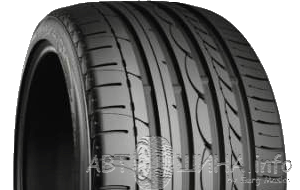
But the most noticeable “side effect” of raising the maximum permitted speed is a substantial increase in the tyre’s price, which often misleads motorists. In their overall concern for their 4-wheeled pet, they often assume that “the more expensive, the better”. When it comes to high-speed tyres, that is not quite true: if you do not drive at 300 km/h, a high-speed tyre does your car more harm than good. You need to understand that such tyres are made specifically for driving at extremely high speeds; they are not just an ordinary “margin of strength”, of which one tyre has more and another less.
The one practical advantage of a high-speed tyre at relatively low speeds (up to 150 km/h) is a lower noise level (related to stiffness, rubber compound and tread pattern). But you should bear in mind that you are most unlikely to hear the difference from an ordinary, good-quality classic symmetric summer tyre inside the car.
So, given the state of the road surface on most roads, it is fair to say that for motorists who do not spend too much time on European motorways with no speed limit, a high-speed tyre is far from the most rational choice. You can show it off to friends and colleagues (as in, “look what an expensive tyre I bought”), but in everyday use you will certainly lose out compared with cheaper, less high-speed alternatives.
The simple conclusion is that for the vast majority of motorists a speed rating of V (up to 240 km/h) is more than enough for summer tyres, and T (up to 190 km/h), accordingly, for winter ones. And that is already with a margin of strength, since even at those speeds it is extremely dangerous to drive on ordinary roads, whatever tyre is fitted.
See all the articles in the category “Choosing a summer tyre”
 Speed rating, load index, and tyre season markings againA tyre’s speed rating and load index are figures you must pay attention to when buying. The speed rating limits your maximum speed, and the load index shows the maximum weight of the car that can…
Asymmetric treadAsymmetric winter tread: how its outer and inner halves work, and whether it is a good alternative to a classic winter tyre.
Cheap tyres: what to expect of them todaySome motorists are convinced that a cheap tyre is always a lottery, others that only the naive pay extra for a big name on the sidewall.
How does a winter tyre differ from a summer one?Most drivers think winter and summer tyres differ mainly in tread pattern. In fact, the key difference is how the rubber handles temperature.
Speed rating, load index, and tyre season markings againA tyre’s speed rating and load index are figures you must pay attention to when buying. The speed rating limits your maximum speed, and the load index shows the maximum weight of the car that can…
Asymmetric treadAsymmetric winter tread: how its outer and inner halves work, and whether it is a good alternative to a classic winter tyre.
Cheap tyres: what to expect of them todaySome motorists are convinced that a cheap tyre is always a lottery, others that only the naive pay extra for a big name on the sidewall.
How does a winter tyre differ from a summer one?Most drivers think winter and summer tyres differ mainly in tread pattern. In fact, the key difference is how the rubber handles temperature.