Steering wheel vibration: causes

Steering wheel shake: causes and how to cure it
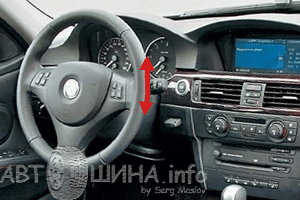
The problem of steering wheel vibration while driving most often crops up for motorists right after a seasonal tyre change, or after hitting a serious pothole, usually at high speed. The symptoms vary: sometimes the steering wheel vibrates constantly, sometimes only at a particular speed, and more rarely the shake defies any systematic pattern and starts at different speeds and on different road surfaces.
In fact, steering wheel vibration while driving (not while braking, this is crucial!) is always the result of a rotational resonance in the unbalanced mass of one or more wheels, and there can be as many as five causes of this (which, incidentally, can add to one another):
1. Simple dirt on the wheel. Some wheel designs are shaped so that mud and slushy road grime collect in certain cavities and do not drain out naturally. Over time, as it freezes (or dries), that dirt creates the very same unbalanced mass which, in turn, causes the wheel to vibrate. So the first thing to do if you notice steering wheel vibration is to wash the wheels thoroughly and make sure there is nothing lodged inside them.
2. A poorly balanced wheel (one or more). This problem is cured only at a tyre fitter’s, and it is the simplest of the possible causes of steering wheel shake (after dirt, of course). If the shake shows up right after a visit to the tyre fitter, go to a different one and check the wheel balancing, but choose a good tyre fitter this time: let it be a lesson for the future, the cheapskate always pays twice!
3. The wheel and/or the tyre has damaged geometry (the maximum permitted runout is exceeded), or in plain terms, it runs out of true. There can be many causes: anything from poor (incorrect) repair of the wheel or the tyre to wrong storage of the tyres between seasons. Strong impacts, an “egg” on the tyre, and simply a breach of the manufacturing process for tyres and wheels (a factory defect) can also lead to runout.
It has to be said that a wheel with runout can perfectly well be balanced “to zero”, but it will still run out of true, putting a dangerous load on the suspension and causing vibration in the steering wheel.
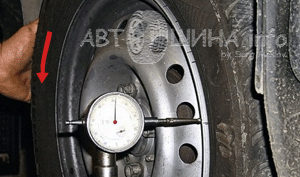
Measuring wheel runout directly on the car
Curing this problem is far from always possible, and the place to start is a good tyre fitter’s, where wheel runout can be measured not “by eye” but with proper instruments. That is also where they will be able to tell you how far the problem can be fixed.
4. A deformed hub or other load-bearing suspension components. This problem can be diagnosed at any garage, or even just in your own garage, by jacking up the wheel fitted to the car and measuring its runout as it turns, using a special instrument. Just make sure, before running this check, that the wheel itself is true (section 3). These problems usually appear after hitting a big pothole or a speed bump at high speed.
5. The wheel fitted to the car incorrectly, or the wheel not matching the hub’s standard dimensions. Try a small experiment: put the wheel onto the hub and start all the bolts (or nuts) without tightening them fully. Then, pressing the wheel firmly against the hub, try to shift the wheel relative to the hub in the vertical plane (up, down, forward or back along the car’s direction of travel). Is there any play? That means the wheel’s centre bore (the hole that centres the wheel on the hub) is bigger than the hub spindle it fits onto.
What does that mean for you? Simply that fitting this wheel to this car without at least a small amount of vertical misalignment is, at best, very difficult, and in real life practically impossible. The only question is how great that misalignment will be. The cure is either to replace the wheels with the correct ones, or to fit special plastic washers of the right size (it is not impossible that you will have to have them made to order for your exact dimensions).
There is also a fairly common mistake made by some motorists and tyre fitters: tightening bolts (or nuts) with a tapered seat incorrectly. They need to be tightened gradually, alternating opposite bolts (or nuts), and the process must start by hand only: no air guns! What is more, the main tightening should be done with the car up in the air; once you lower the car onto its wheels, you can only just “nip up” the bolts (or nuts) a little, never actually tighten them.
Question and answer
- Why does the steering wheel vibrate?
- While driving, steering wheel vibration points to a problem with one or more wheels. The most common causes are: dirt on the wheels, poor balancing, wheel geometry that is out of true, or a faulty suspension.
In this section
 How to choose a tyre fitter?Oh, there’s a shed 300 metres away, what’s there to choose, plenty of motorists will say. And they’ll be wrong: a tyre fitter, and for that matter the fitter you trust with your wheels, needs to be…
Beware the impact wrench!It seems such a routine procedure: doing up bolts with an air gun. Most motorists are used to this step and pay it no attention at all.
Alloy wheel repairAt first glance the question is simple, since the answer to it is right there on the signs outside most tyre-fitting workshops. If alloy wheels are repaired, that must mean it’s allowed?
How often should you balance your wheels?How often should you balance your wheels? At each seasonal swap, after hitting a pothole, every 15,000 km and before a long trip. Here is why.
A punctured tyre: what can be repaired and what cannot“A string plug from outside, five minutes and off we go,” promises the roadside tyre fitter, and the wheel is not even taken off the car. Quick, cheap, and the tyre seems to hold air.
How to choose a tyre fitter?Oh, there’s a shed 300 metres away, what’s there to choose, plenty of motorists will say. And they’ll be wrong: a tyre fitter, and for that matter the fitter you trust with your wheels, needs to be…
Beware the impact wrench!It seems such a routine procedure: doing up bolts with an air gun. Most motorists are used to this step and pay it no attention at all.
Alloy wheel repairAt first glance the question is simple, since the answer to it is right there on the signs outside most tyre-fitting workshops. If alloy wheels are repaired, that must mean it’s allowed?
How often should you balance your wheels?How often should you balance your wheels? At each seasonal swap, after hitting a pothole, every 15,000 km and before a long trip. Here is why.
A punctured tyre: what can be repaired and what cannot“A string plug from outside, five minutes and off we go,” promises the roadside tyre fitter, and the wheel is not even taken off the car. Quick, cheap, and the tyre seems to hold air.