Alloy wheel repair
At first glance the question is simple, since the answer to it is right there on the signs outside most tyre-fitting workshops. If alloy wheels are repaired, that must mean it’s allowed?

Can cast alloy wheels be repaired?
Despite being considerably more resistant (compared with steel wheels) to mechanical damage from hitting a pothole, striking a kerb, driving over a “sleeping policeman” and so on at high speed, cast alloy wheels often either lose their geometric shape (bend) or partly fail (chips, cracks, lost fragments) after such impacts. Clearly, the extent of the damage depends directly on the speed and the profile of the road surface, which, in turn, determine the force of the impact on the wheel, and the point where that force is applied.
Can a damaged cast alloy wheel be restored?
In the overwhelming majority of cases, cast alloy wheels cannot be restored, but the precise answer to this question depends heavily on the nature and extent of the damage to the wheel, and on the method you are offered for the repair. The main thing to understand is that cast alloy wheels are made by pouring molten alloy into a special mould, after which a process of heat treatment and artificial ageing always follows. It is precisely this technology that gives a finished cast alloy wheel all its consumer properties.
Welding cast alloy wheels
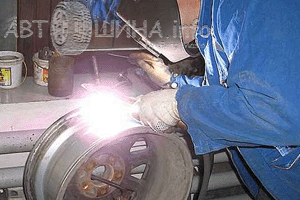
Cracks, chips, and broken-off fragments of a cast alloy wheel are usually offered a cure at tyre centres using TIG (argon) welding of wheels. On closer inspection, this method can only restore the wheel’s appearance, not its fitness for further use as intended.
Given the structure of the alloy in a finished wheel, and the physics of heating the alloy and then cooling it, one thing is beyond doubt: a cast alloy wheel must never, under any circumstances, be heated, neither locally nor all over. And however much the staff at a tyre centre may praise their equipment and skills, you need to understand that restoring the alloy’s original structure under tyre-centre conditions (any tyre centre) is simply impossible. Even assessing that structure requires the resources of a research institute, and reproducing it, on top of that, requires full factory conditions.
Rather than going into a detailed justification of this position using terms unfamiliar to most consumers, such as “residual deformation”, “absorption energy” or “internal stress in the metal”, let’s simply quote section 2.3 of the “Safety and Service Recommendations for Wheels”, published by the European Wheel Manufacturers’ Association (EUWA, Association of European Wheel Manufacturers):
“Any repair of damage to the rim or wheel by heating, welding, adding or removing material is absolutely prohibited”. Similar recommendations exist at every organisation involved, to one degree or another, in the manufacture of cast alloy wheels.
What does that mean? It means that under any heating (including during welding), the alloy the wheel is made from completely changes its structure and properties, and is then simply no longer physically able to withstand the loads placed on a car’s wheel. The consequences will depend heavily on the specific situation, ranging from distorted wheel geometry after a relatively small pothole or rut, to complete failure in more serious situations on the road and/or at high speed. And as for what losing a wheel at high speed risks, it is better not even to think about it.
Driving on a wheel that has undergone any kind of heat treatment (heating) is not just inadvisable: it is categorically forbidden and dangerous! And there is no room for compromise here, and there never can be.
Straightening (truing) cast alloy wheels
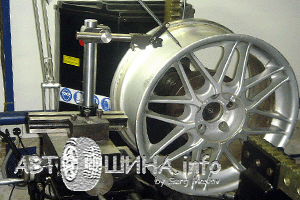
Straightening (truing) a cast alloy wheel is usually offered by tyre centres in cases where, during a routine tyre fitting, it turns out the wheel has some deformation causing radial or lateral runout (in plain words, the wheel runs out of true). The straightening itself is done on equipment similar to that used for straightening steel wheels, but fitters at tyre fitters’ often heat the deformed areas of the wheel with a blowtorch or by some other means. Wheels must never be repaired this way! (the answer to the question “why?” is above).
The only relatively safe option is to try to “knock out” the bent (deformed) areas of the rim and then straighten it without heating. But this process is fairly labour-intensive and lengthy, so the price of such a repair is fairly high, and far from every fitter will take it on.
And this is only relevant in the mildest cases, where in principle you could do without straightening the wheel at all, because with more serious deformation it is no longer possible to properly “knock out” the wheel, at least not without heating it.
It is very important to understand that a cast alloy wheel that has been heated is, in any case, already unfit to be fitted to a car, so when buying used cast alloy wheels you must always inspect every surface of each wheel carefully. Heating usually leaves telltale marks on the wheel that cannot be washed off. So, if the wheels have not been repainted, spotting past heating on a wheel is usually not difficult.
Repainting cast alloy wheels
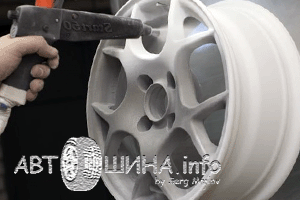
Many modern tyre centres offer a powder-coat repainting service for cast alloy wheels. Is it worth spending money on how the wheels look?
Restoring a wheel’s paintwork is possible in principle, but it should be done by professionals, and specifically specialists in painting wheels, not specialists in painting car bodywork, because the quality requirements for painting wheels are much higher. After all, a wheel’s paintwork is exposed far more to dirt, water and the de-icing chemicals spread (or sprayed) on the streets in winter than any part of a car’s bodywork, wouldn’t you agree?
So, the wheel needs to be properly prepared for painting, by fully removing the old paintwork. On top of that, after painting the wheel must always be checked for static imbalance caused by an uneven layer of paint and lacquer on different parts of the wheel’s surface. And for that, you need special equipment as a bare minimum.
General recommendation: if you have decided to have your cast alloy wheels repainted, you need to find specialists in this field who have the right facilities and equipment, as well as good reviews and recommendations. After that, it is strongly recommended that you sign a written contract setting out the warranty obligations for the work done. Without all of this, you run a serious risk of ending up with wheels unfit for further use, or wheels that simply lose their looks.
 How to choose a tyre fitter?Oh, there’s a shed 300 metres away, what’s there to choose, plenty of motorists will say. And they’ll be wrong: a tyre fitter, and for that matter the fitter you trust with your wheels, needs to be…
How are alloy wheels madeHow alloy wheels are made: a video that clearly shows the manufacture of forged and cast wheels.
How do you choose spigot rings?How to choose spigot rings for wheels: when they help, why you must not bore out the centre bore, and whether plastic or aluminium is better.
Quality marks on alloy wheels: what to look for besides the priceA wheel seller will gladly tell you about the spoke design, the colour and “forged strength” at a cast price. Who tested the wheel, and how, comes up far less often.
How do cast alloy wheels differ from steel ones?How do cast alloy wheels differ from steel ones? Weight, price, looks, and a few differences that only show up in everyday use.
How are cast alloy wheels made?How are cast alloy wheels made? The name says it: they are cast in a ready-made mould.
How to choose a tyre fitter?Oh, there’s a shed 300 metres away, what’s there to choose, plenty of motorists will say. And they’ll be wrong: a tyre fitter, and for that matter the fitter you trust with your wheels, needs to be…
How are alloy wheels madeHow alloy wheels are made: a video that clearly shows the manufacture of forged and cast wheels.
How do you choose spigot rings?How to choose spigot rings for wheels: when they help, why you must not bore out the centre bore, and whether plastic or aluminium is better.
Quality marks on alloy wheels: what to look for besides the priceA wheel seller will gladly tell you about the spoke design, the colour and “forged strength” at a cast price. Who tested the wheel, and how, comes up far less often.
How do cast alloy wheels differ from steel ones?How do cast alloy wheels differ from steel ones? Weight, price, looks, and a few differences that only show up in everyday use.
How are cast alloy wheels made?How are cast alloy wheels made? The name says it: they are cast in a ready-made mould.