How to choose a tyre fitter?
Oh, there’s a shed 300 metres away, what’s there to choose, plenty of motorists will say. And they’ll be wrong: a tyre fitter, and for that matter the fitter you trust with your wheels, needs to be chosen carefully!

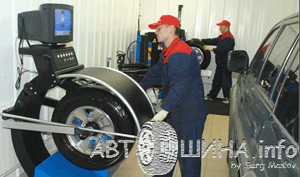
Very often on regional car forums you can find motorists asking things like “Recommend a mechanic or garage for suspension work (engine, gearbox, and so on)”, but recommendations for tyre-fitting workshops are asked for rarely. Why is that? Because poor-quality suspension, engine or gearbox repairs, and even a poor paint job on the car’s bodywork, are entirely obvious and “come back to bite you” very quickly, whereas the results of poor tyre fitting and wheel balancing are not so obvious, and even when problems do turn up, it is not always possible to work out which fitter cut corners, and when.
Although, in fact, the quality of the work done by a tyre centre’s fitters affects a great deal, from how long your car’s suspension lasts to how the car behaves (its stability on the road) in extreme situations. Remember that if the engine stalls on the road, your car will simply come to a stop and go no further, but if a tyre bursts, a wheel comes off, or a wheel bearing simply falls apart because of poor balancing, the consequences can be extremely sad.
That is why experienced motorists treat a tyre fitter as a fully-fledged service centre and, accordingly, choose their fitter just as scrupulously as they would choose a garage for diagnosing and repairing the suspension or the engine. Instead of answering the question “Why?”, let’s list the main consequences of a tyre-fitting workshop’s staff doing a poor job on your wheels.
What a poor job by a tyre fitter leads to:
1. Poor wheel balancing (including a poor check for deformation of the wheel and the tyre) causes the wheel to run out of true on the hub, which, in turn, puts extreme loads on the wheel bearing, the ball joints, the track rod ends, the CV joint, and the suspension struts (including their top mount bearings). Under normal conditions, this simply leads to a significant cut in the service life of these components (by several times over) and sometimes to steering wheel vibration, while under extreme conditions it can quite easily lead to their sudden failure (it is better not even to think about the consequences).
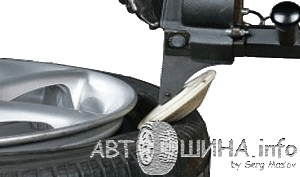
2. Poor tyre fitting (fitting the tyre to the wheel) can damage the tyre’s structure, which is not visible once the wheel is assembled, but under extreme load can cause the wheel to burst suddenly (what that would lead to at high speed, use your imagination). What’s more, an outdated tyre changer without plastic protection on its clamping jaws will inevitably scratch your new alloy wheels.
3. Poor tyre repairs can cause runout in the wheel that cannot be removed on the wheel balancer (for the consequences, see point 1). What’s more, some tyre-fitting workshops take on repairing tyres that are not repairable at all, without warning the motorist that using these tyres after the repair is dangerous to life: this, above all, is irresponsibility.
4. Removing a wheel incorrectly (especially if the wheel has seized onto the hub) will damage the wheel, the hub and suspension parts, and the damage may not show up straight away but, say, a week or two later, by which time you won’t be able to make a claim against anyone.
5. Fitting the tyre to the wheel incorrectly (ignoring the tyre’s directionality, the requirements on the outer and inner side, and so on) will significantly worsen the tyre’s performance and considerably speed up its wear.
6. Incorrect tyre pressure (including because of a faulty pressure gauge) will lead to faster, uneven tyre wear, as well as worse grip on the road and directional stability.
7. Incorrect seasonal storage of tyres (where this service is offered) will lead to the complete loss of their performance properties and the need to buy a new set of tyres.
So, irresponsibility, incompetence and/or the absence of modern, properly working equipment at a tyre centre (any one of these is enough) will most likely lead to a significant rise in what it costs you to keep your car on the road, and in some cases will create a real threat to the life of the driver, passengers and other road users. So choosing a tyre fitter is not nearly as simple or trivial a question as it looks at first glance.
What criteria should you use to choose a tyre centre?
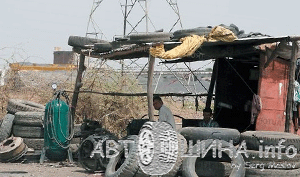
First of all, you should avoid roadside sheds (portable cabins) with “tyre fitting” hand-painted on them in oil paint. These workshops are fine for servicing local motorbikes, Moskvichs, Ladas and tractors. Well, perhaps also for extreme situations, when there is no alternative within a 10-20 km radius and you have to get somewhere. But even then, any work done at a place like this absolutely must be checked (and redone) at the first decent tyre centre you find, even if the car seems to be behaving normally.
Second, never choose a tyre fitter based only on how close it is to home (or work) and/or the lowest price for the service. If you live in a big city, within a 3-4 km radius you will most likely find a good ten different tyre centres, so you will have plenty to choose from. And there is no need to remind you of the old saying “The cheapskate pays twice”, which, incidentally, is especially apt in this case.
Third, try to have your wheels serviced at the same tyre fitter’s all the time, ideally by the same fitter: knowing your car, your wheels and the conditions they’re used in will make it easier for the fitter to do a good job, and it will also significantly raise his sense of responsibility, because if problems do arise, you can only have a claim against him.
Fourth, weigh up how the tyre fitter’s owner treats the staff and their working conditions. If nobody has cleaned the workshop for a month, the fitters are wearing filthy overalls (that haven’t seen washing powder in half a year), you can smell stale alcohol on them from a mile off, and the tools are lying around wherever, then this is definitely not the place for you: nobody there will be able to do any job properly, and the skill of any one particular fitter counts for absolutely nothing here.
Fifth, pay attention to the equipment and tools. Everything should be clean and tidy. The wheel balancer must be mounted on a concrete base and firmly secured, otherwise its readings are simply numbers plucked out of thin air. The tyre changer’s clamping jaws should have special plastic pads to avoid scratching the wheel. The set of tools must be able to handle every possible problem that comes up with the main jobs. Ask the fitters a silly question: when were the pressure gauges and the wheel balancer last calibrated (there should be paperwork)? This is very important, which is why the owners of properly run tyre centres do it regularly.
What good tyre centres NEVER do:
- Never hit a wheel with an iron hammer or a sledgehammer (under any circumstances).
- Never balance dirty wheels (there is no point at all: both the tyre and the wheel need to be cleaned thoroughly first).
- Never leave the old balance weights on before balancing (this must never be done).
- Never do up bolts (or nuts) with an impact wrench when fitting a wheel to the hub (undoing bolts with an air gun is fine, but doing them up and tightening them must be done by hand only, otherwise the wheel’s centring on the hub cannot be guaranteed).
- Never repair alloy wheels using any kind of heating (once a cast alloy wheel has been heated, you might as well throw it away).
- Never repair radial tyres with a damaged carcass (this mostly means sidewall cuts: the design of a radial tyre means the carcass is fundamentally unrepairable, and continuing to use it after a repair is dangerous to life).
- Never stop a customer checking the balancing results for themselves (usually there’s a window opposite the wheel balancer’s monitor, through which the customer can see the data on the screen from outside or from the waiting room).
- Never brush off a customer’s questions, and always explain in detail what needs to be done, how, and why.
- Never recommend inflating tyres with gas mixtures (a cylinder of nitrogen mix may well be kept on hand for customers who insist on inflating their tyres with gas, but a good, responsible fitter will never push this pointless waste of money on you).
- Never let a customer go without checking the pressure in all the tyres (even if only one was repaired).
Always remember that the services tyre centres provide have a direct impact on road safety, and so you can and should keep an eye on the quality of all the work done and insist that every rule and procedure is followed properly.