How often should you balance your wheels?
How often should you balance your wheels? At each seasonal swap, after hitting a pothole, every 15,000 km and before a long trip.

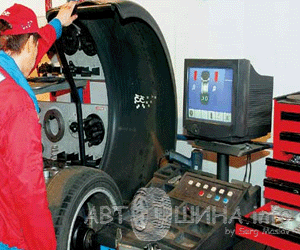
Following on from the previous article on why wheel balancing is needed, we conclude that wheel balancing is needed after all. The next natural question is: how often, or in which cases, must it be done? To answer that, let’s recall the conditions a wheel works in, and the technology used to balance it.
So, wheel balancing is done by fitting balance weights to the surface of the wheel. These weights are either stuck to the wheel (which is the usual method for most alloy wheels) or clipped onto the wheel’s rim flange. Either way, while the wheel is in use, especially after impacts of varying force, and also when washing it under high pressure, the weights sometimes fly off, which on its own is reason enough for an unscheduled visit to the tyre fitter.
What’s more, hard starts and emergency braking, as well as taking corners at speed, cause uneven tread wear, which also throws off the results of wheel balancing. And driving over large potholes, speed bumps, ruts and other road irregularities at speed carries a fairly high risk of damaging the wheels’ geometry, which makes it dangerous to keep using them.
Perfect wheel balancing is physically impossible, and in most cases is not necessary anyway. Even so, how much balancing accuracy matters for safe driving depends directly on your driving style and the speeds you drive at. It is also worth remembering that wheel balancing checks the wheels’ geometry too, so the procedure always has a positive effect on road safety.
So, wheel balancing definitely needs to be checked or done:
- When you change wheels or tyres for the season (even if you have two sets of wheels and no tyre fitting is involved in the changeover).
- If you hit a pothole, strike a kerb, or drive over a speed bump at speed, and so on.
- Every 15 thousand km (this is the car manufacturers’ firm recommendation, and given everything said above, it is hard to disagree with). That said, most motorists do not usually cover more than 15 thousand km a season, so this rule is normally covered anyway by balancing at the seasonal wheel change.
- Before and after a long trip (when the total expected distance is more than 2 thousand km).
If you prefer aggressive driving at high speeds, it is worth thinking about checking the wheel balancing every 7-8 thousand km, in other words twice as often as the car maker recommends. Remember that any problem with a wheel, however minor, can lead to very serious trouble on the road at high speed, so wheels always deserve special attention.
In this section
 How to choose a tyre fitter?Oh, there’s a shed 300 metres away, what’s there to choose, plenty of motorists will say. And they’ll be wrong: a tyre fitter, and for that matter the fitter you trust with your wheels, needs to be…
Beware the impact wrench!It seems such a routine procedure: doing up bolts with an air gun. Most motorists are used to this step and pay it no attention at all.
A cut in the sidewall: repair or scrap?Sadly, any damage to the sidewall of a radial tyre is, in all likelihood, already the end of its service life. Even so, many tyre fitters take on the repair of sidewall cuts in car tyres.
Alloy wheel repairAt first glance the question is simple, since the answer to it is right there on the signs outside most tyre-fitting workshops. If alloy wheels are repaired, that must mean it’s allowed?
How to choose a tyre fitter?Oh, there’s a shed 300 metres away, what’s there to choose, plenty of motorists will say. And they’ll be wrong: a tyre fitter, and for that matter the fitter you trust with your wheels, needs to be…
Beware the impact wrench!It seems such a routine procedure: doing up bolts with an air gun. Most motorists are used to this step and pay it no attention at all.
A cut in the sidewall: repair or scrap?Sadly, any damage to the sidewall of a radial tyre is, in all likelihood, already the end of its service life. Even so, many tyre fitters take on the repair of sidewall cuts in car tyres.
Alloy wheel repairAt first glance the question is simple, since the answer to it is right there on the signs outside most tyre-fitting workshops. If alloy wheels are repaired, that must mean it’s allowed?