Beware the impact wrench!
It seems such a routine procedure: doing up bolts with an air gun. Most motorists are used to this step and pay it no attention at all.

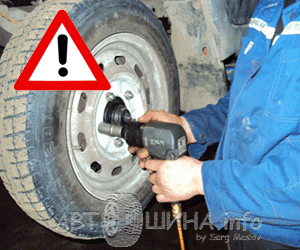
Have you never read the bemused reviews on car forums from motorists who, a dozen or so kilometres after a visit to the tyre fitter’s or a garage, discover that the bolts on one (or more) wheel are not just loose, but actually undone or even missing? And the strangest thing is that the wheel was bolted on in front of the “victim” himself! So situations like this usually get blamed on spiteful neighbours. In fact, the cause of this is, most often, the impact wrench.
Air guns (impact wrenches), thanks to their low cost, have in recent years become a fixture of the toolkit found in practically every tyre-fitting workshop or garage. An impact wrench genuinely speeds up the process of removing and fitting a wheel considerably, and makes the fitter’s job noticeably easier. The trouble is, very few motorists know that doing up and tightening wheel bolts (or nuts) with an impact wrench is strictly forbidden!
How are impact wrenches built?
The design of the impact wrenches used at tyre fitters’ is fairly simple: the air gun is connected to a compressor hose and driven by high-pressure air. An important part of the air gun’s design is the ability to adjust the maximum force transmitted to the impact wrench’s chuck, which, among other things, lets you adjust the tightening torque of the bolts (or nuts). This is exactly the main argument tyre fitters make in favour of using an impact wrench to tighten bolts: the tightening torque is set to a minimum, so the bolts (or nuts) will not be “overtightened”.
In fact, air tools should not be used for fitting a wheel to the hub, and it is not about the tightening force at all, although, given that in the overwhelming majority of cases the impact wrenches at tyre centres are cheap Chinese-made tools, and the torque adjustment is the first thing to break on them (if it ever worked at all), there is absolutely no reason to trust these devices, and a situation where problems turn up the next time the wheel is removed is more than likely, and it happens in real life. But the real issue isn’t even that the bolts might be fitted too tight (or too loose) when the wheel is mounted.
Why do wheel bolts (or nuts) have a tapered seat?
You have probably noticed that the bolt holes on a wheel have a much bigger diameter than the thread of the bolts (or studs) that fasten the wheel to the hub? And, correspondingly, that the bolts (or nuts) themselves have a head with a tapered seat? Have you ever wondered why it’s made that way? It’s made that way because the car manufacturer has to calculate the fit of the wheel on the hub extremely precisely, so that the wheel’s axis of rotation lines up exactly with the hub’s axis of rotation. If those axes don’t line up, the wheel will run out of true, literally destroying the wheel bearing and other load-bearing suspension components. And the task is not just to “seat” the wheel correctly on the hub, but also to fasten it securely in that position along every load axis. That is exactly why there is a centre bore in the wheel (for the correct fit) and rules for tightening the wheel bolts in a set order and in stages: to hold it securely in the right position. More on the purpose of the centre bore and the tapers is in the article on spigot rings. By tightening the bolts (or nuts) by the book, that is, by hand, without rushing, in a star pattern and in several stages, you ensure the most precise centring of the wheel’s bolt holes on the bolts’ tapered seats (or nuts), and, correspondingly, the most secure fastening of the wheel to the car’s hub in the right position. So what happens when the bolts are done up with an impact wrench? One bolt (or nut) is driven in (and tightened) at high pressure and high speed, regardless of whether it has “seated” correctly in the wheel’s bolt hole and whether the other holes have lined up correctly with the hub’s studs (threaded holes). After that, all the other bolts are then forced to tighten based on whatever position the wheel ended up in relative to the hub when the first bolt was tightened.
Just out of curiosity, try putting a wheel on the hub and doing up only one bolt (or nut), without tightening it fully: you will see that the wheel has quite serious “play” in it
What can happen if bolts (or nuts) are tightened with an impact wrench?
If the wheel has seated on the hub incorrectly, that means the bolt holes in the wheel and the tapered seats of the bolts or nuts have “seated” incorrectly. And that, in turn, means that while the car is being driven, two forces will collide: either the wheel, running out of true, will destroy the bearing (relevant in cases where the diameter of the wheel’s centre bore does not exactly match the diameter of the hub’s seating cylinder), or the wheel will actually shift (for example, under emergency braking) and then settle into place (depending on the actual tightening torque of the bolts). In the first case the consequences are obvious, and in the second, once the bolts settle into place, it turns out that they are… undertightened! And after that, wheel vibration and centrifugal force will inevitably do their work: the bolts (or nuts) will come loose sooner or later. Good, if you manage to notice it in time…
Of course, the chance that the wheel will “seat” correctly on the hub straight away, and that the bolt (or nut) tapers will “seat” correctly in their places, doesn’t just exist: it is fairly high (especially if the diameter of the wheel’s centre bore exactly matches the hub’s cylinder), but there is also a chance of the wheel being fitted incorrectly, which is most unlikely to happen with correct hand-tightening of the bolts. So always insist that the wheel is done up and tightened by hand, and with the car up in the air: fully tightening the bolts (or nuts) after lowering the car off the jack can lead to exactly the same consequences.
 How to choose a tyre fitter?Oh, there’s a shed 300 metres away, what’s there to choose, plenty of motorists will say. And they’ll be wrong: a tyre fitter, and for that matter the fitter you trust with your wheels, needs to be…
Spigot rings for wheels: everything you need to knowSpigot rings (hub-centric rings) for wheels: some say they are unnecessary, others that they are essential. Why you may need them and how to choose them.
How do you choose spigot rings?How to choose spigot rings for wheels: when they help, why you must not bore out the centre bore, and whether plastic or aluminium is better.
Tyre rotation: why, when and in what patternTyre fitters put “wheel rotation” on a line of its own in their list of services and advise doing it every season, while car forums warn just as confidently: never swap your wheels around.
A cut in the sidewall: repair or scrap?Sadly, any damage to the sidewall of a radial tyre is, in all likelihood, already the end of its service life. Even so, many tyre fitters take on the repair of sidewall cuts in car tyres.
What affects the quality of wheel balancingWhat affects the quality of wheel balancing: the machine or the fitter’s skill? And why a wheel balanced “to zero” is not automatically safe.
How to choose a tyre fitter?Oh, there’s a shed 300 metres away, what’s there to choose, plenty of motorists will say. And they’ll be wrong: a tyre fitter, and for that matter the fitter you trust with your wheels, needs to be…
Spigot rings for wheels: everything you need to knowSpigot rings (hub-centric rings) for wheels: some say they are unnecessary, others that they are essential. Why you may need them and how to choose them.
How do you choose spigot rings?How to choose spigot rings for wheels: when they help, why you must not bore out the centre bore, and whether plastic or aluminium is better.
Tyre rotation: why, when and in what patternTyre fitters put “wheel rotation” on a line of its own in their list of services and advise doing it every season, while car forums warn just as confidently: never swap your wheels around.
A cut in the sidewall: repair or scrap?Sadly, any damage to the sidewall of a radial tyre is, in all likelihood, already the end of its service life. Even so, many tyre fitters take on the repair of sidewall cuts in car tyres.
What affects the quality of wheel balancingWhat affects the quality of wheel balancing: the machine or the fitter’s skill? And why a wheel balanced “to zero” is not automatically safe.