What level of imbalance is considered normal?
What is the maximum permitted mass of balance weights, and what criteria tell good wheels or tyres apart from bad ones?

Of course, making a perfect wheel is impossible, and since we are talking about a wheel-and-tyre set, the quality of the complete wheel depends directly on the quality of each of these components. That is why there are certain ranges, tolerances, within which the imbalance present is considered acceptable.
| Tyre type / designation | Rim diameter, inches | Maximum permitted mass of balance weights when balancing (total per wheel), grams | Maximum permitted tyre runout, mm | |
|---|---|---|---|---|
| radial | lateral | |||
| Radial (all sizes) | 12" | 50 | 1.0 | 1.5 |
| 13" | 60 | 1.0 | 1.5 | |
| 14" | 70 | 1.0 | 1.5 | |
| 15" | 70 | 1.5 | 2.0 | |
| 16" | 70 | 1.5 | 2.0 | |
| 215/80 R16 C | 16" | 140 | 1.5 | 2.0 |
| 225/75 R16 C | 16" | 160 | 1.5 | 2.0 |
| Cross-ply (all sizes) | 13" | 80 | 2.0 | 3.0 |
| 14" | 100 | |||
| 15" | 140 | |||
| 175/80-16 | 16" | 120 | ||
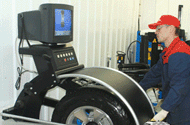
While measuring the static imbalance of the tyre itself, without the rim, is, for an ordinary motorist or tyre fitter, practically an impossible task, assessing the imbalance of the assembled wheel (from the mass of the balance weights used) and assessing the radial and lateral runout of the wheel is fairly easy to do during balancing. That said, to measure a wheel’s runout accurately you need to find a tyre fitter with the special equipment for it.
The interstate standard GOST 4754-97 was in force in Ukraine in those years (“Pneumatic tyres for passenger cars, their trailers, light trucks and buses of extra small capacity. Specifications”, introduced in 1999). Among other things, this standard sets out the maximum permitted values for static imbalance, the mass of the corrective weights needed to offset dynamic imbalance, and the maximum permitted figures for wheel runout (see the table).
Note that the standard does not set tolerances for radial tyres whose rim diameter is over 16 inches, and also that the maximum permitted safe values in the standard are based on the traffic regulations in force. So if you sometimes allow yourself to break the speed limit, your own personal requirements should be somewhat stricter than the standard, directly depending on speed (the higher the speed, the stricter the requirements should be).
It is also worth noting that failing to meet the requirements of GOST 4754-97 the first time a wheel is balanced is grounds for returning or exchanging a new wheel or a new tyre at the shop, though you will need to get it all down on paper.
 How to choose a tyre fitter?Oh, there’s a shed 300 metres away, what’s there to choose, plenty of motorists will say. And they’ll be wrong: a tyre fitter, and for that matter the fitter you trust with your wheels, needs to be…
Beware the impact wrench!It seems such a routine procedure: doing up bolts with an air gun. Most motorists are used to this step and pay it no attention at all.
Alloy wheel repairAt first glance the question is simple, since the answer to it is right there on the signs outside most tyre-fitting workshops. If alloy wheels are repaired, that must mean it’s allowed?
How to choose a tyre fitter?Oh, there’s a shed 300 metres away, what’s there to choose, plenty of motorists will say. And they’ll be wrong: a tyre fitter, and for that matter the fitter you trust with your wheels, needs to be…
Beware the impact wrench!It seems such a routine procedure: doing up bolts with an air gun. Most motorists are used to this step and pay it no attention at all.
Alloy wheel repairAt first glance the question is simple, since the answer to it is right there on the signs outside most tyre-fitting workshops. If alloy wheels are repaired, that must mean it’s allowed?