What kinds of wheel imbalance are there?

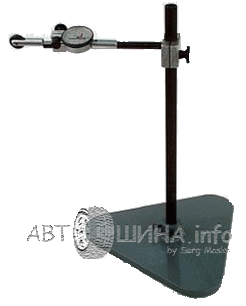
Instrument for measuring wheel runout
What kinds of wheel imbalance are there?
Imbalance can be static or dynamic. In both cases the issue is a mismatch between the axis of rotation and the axis of inertia (the latter running through the wheel’s centre of gravity). Let’s try to decode these terms in plain language.
Static imbalance arises when the wheel’s axis of rotation is parallel to the axis of inertia, and the centre of gravity does not sit on the axis of rotation at all (the wheel’s mass is unevenly spread around the circumference). In this case, if you put the wheel on a freely spinning axle, you can watch it swing a few times like a pendulum and come to rest with the centre of gravity at the lowest point.
Dynamic imbalance arises when the centre of gravity sits on the axis of rotation, but the axis of inertia does not coincide with the axis of rotation, crossing it at a certain angle (the wheel’s mass is unevenly spread across its width). In this case imbalance can only be identified while the wheel is turning.
Tyre-fitting technicians eliminate both static and dynamic wheel imbalance by fitting balance weights on both sides of the wheel’s rim at particular points.
 How to choose a tyre fitter?Oh, there’s a shed 300 metres away, what’s there to choose, plenty of motorists will say. And they’ll be wrong: a tyre fitter, and for that matter the fitter you trust with your wheels, needs to be…
Beware the impact wrench!It seems such a routine procedure: doing up bolts with an air gun. Most motorists are used to this step and pay it no attention at all.
Alloy wheel repairAt first glance the question is simple, since the answer to it is right there on the signs outside most tyre-fitting workshops. If alloy wheels are repaired, that must mean it’s allowed?
A punctured tyre: what can be repaired and what cannot“A string plug from outside, five minutes and off we go,” promises the roadside tyre fitter, and the wheel is not even taken off the car. Quick, cheap, and the tyre seems to hold air.
How to choose a tyre fitter?Oh, there’s a shed 300 metres away, what’s there to choose, plenty of motorists will say. And they’ll be wrong: a tyre fitter, and for that matter the fitter you trust with your wheels, needs to be…
Beware the impact wrench!It seems such a routine procedure: doing up bolts with an air gun. Most motorists are used to this step and pay it no attention at all.
Alloy wheel repairAt first glance the question is simple, since the answer to it is right there on the signs outside most tyre-fitting workshops. If alloy wheels are repaired, that must mean it’s allowed?
A punctured tyre: what can be repaired and what cannot“A string plug from outside, five minutes and off we go,” promises the roadside tyre fitter, and the wheel is not even taken off the car. Quick, cheap, and the tyre seems to hold air.