A punctured tyre: what can be repaired and what cannot
“A string plug from outside, five minutes and off we go,” promises the roadside tyre fitter, and the wheel is not even taken off the car. Quick, cheap, and the tyre seems to hold air.

After every nail in a wheel the same argument flares up on car forums: one person writes that he “put in a string plug and drove on it for three years”, another that a plug is “only good for getting to a tyre fitter”, a third that a punctured tyre is best thrown away at once. In fact each is partly right, so let us sort out what can be cured and what cannot.
A puncture of up to 6 mm in the central part of the tread of a car tyre can be repaired properly, and after a correct repair you carry on driving on it. The key word is “correct”: from the inside, after the tyre has been taken off the wheel and inspected. Anything else is either a temporary fix or a lottery.
Why is that? What holds the air in a tubeless tyre is not the tread but a thin airtight layer of rubber on the inside; under the tread lies the belt, a band of steel cord. A nail goes right through all of this, and a repair has to do two things: fill the puncture channel so that no water gets into it from the road (otherwise the steel cord of the belt rusts and in time the tread may peel away), and seal the inner layer so that the air does not escape from the tyre. A string plug put in from outside fills the channel after a fashion but does not seal the inner layer; a patch without a plug does the opposite and leaves the channel open to water. So the industry rules state outright that a repair with only a plug or only a patch is unacceptable. It is like a tooth: no dentist puts in a filling without looking at what is under the little hole, do they?
Where can a puncture be repaired?
The British standard BS AU 159 and the rules of the US tyre manufacturers’ association (USTMA) agree on the main point: you can repair only a puncture no more than 6 mm across in the central part of the tread. At British tyre fitters this area is described as roughly three quarters of the tread width, without the edges. A nail, a self-tapping screw, a small bolt: yes; a ragged hole larger than 6 mm: no, whatever you are told about a bigger “mushroom”.
The shoulder (the edge of the tread where it turns into the sidewall) is already out of bounds. The belt ends there, the rubber constantly flexes and heats up, and a patch does not hold for long. The same goes if the nail went in at an angle towards the shoulder: at the slightest doubt about whether the shoulder is affected, the tyre is scrapped. And the sidewall of a radial car tyre is never repaired, under any conditions (more on sidewall cuts).
Which punctures can no longer be repaired?
Sometimes the place is right and the nail is small, yet the tyre still has to be replaced:
1. The tyre has been driven flat. Even a short drive on a deflated wheel can destroy the tyre from the inside, and from the outside you cannot see it. I once limped on a flat wheel to a petrol station: outwardly the tyre looked like new (and inside, the fitter showed me grey dust all the way round). The tyre went for scrap.
2. A new patch would go on top of an old one. Patches must not be laid one over another. The British standard does not limit how many repairs there may be, but I would not buy a part-worn tyre with three or more patches. And a high-speed tyre, by the rules of some manufacturers, keeps its speed rating only if it has been repaired just once.
3. The tread is worn down to the wear indicators. There is no point patching such a tyre, and driving a car with a tread depth of less than 1.6 mm is forbidden anyway, in the EU as in Ukraine (clause 31.4.5 of its traffic regulations).
4. There is sealant from a repair kit inside. One of the largest European motoring clubs states outright that after sealant, professional repair of the tyre is forbidden even in a qualified workshop. American industry rules are milder and refer to the tyre maker’s recommendations, but even so the can is a way to get home, not a repair (more on driving without a spare wheel).
5. A tyre “with a surprise”. With run-flat tyres the manufacturers disagree among themselves: some do not recommend any repair, others allow it once (on the repairability of run-flat tyres). Tyres with sound-absorbing foam (common on electric cars, Tesla included) or a self-sealing layer inside can be repaired, but using a separate technique (the foam, for instance, is cut out around the puncture).
And “just fitting an inner tube” in a tubeless tyre is not a repair but a way of hiding the problem.
String plug or “mushroom”?
A string plug is a rubber strip impregnated with glue, which is pushed into the puncture from outside with an insertion tool, without taking the wheel off. Nobody takes the tyre off the wheel or looks inside, so neither traces of driving on a flat nor the true direction of the channel can be seen. A string plug is a way to reach the tyre fitter, not a repair to drive on for years. Will a tyre with a plug last “another three years”? It cannot be ruled out, but the stake will be the belt. And bear in mind that neither the American industry rules nor the British standard allow a tyre with a string plug already in it to be repaired: it can only be replaced. So if you have a spare wheel, fit it.
A “mushroom” is a plug and a patch in one piece: the stem fills the channel, the cap seals the inner layer. It is fitted only from the inside: the tyre is taken off the wheel and inspected in good light, the channel is cleaned out, the area for the patch is buffed, and only then is the “mushroom” bonded in. After this the wheel must be balanced, since a patch adds mass at one point.
To sum up: a puncture in the centre of the tread of up to 6 mm, in a tyre that has no string plug and has not been driven flat, is repaired with a “mushroom” from the inside, and you can go on driving on it; the shoulder and the sidewall are never repaired. Demand that the tyre fitter take the tyre off the wheel, show it to you from the inside, fit a “mushroom” and balance the wheel. And if the fitter, having looked inside, says “it can’t be done here”, thank him: he has just turned down easy money for the sake of your safety.
Question and answer
- Can a puncture in the shoulder of a tyre be repaired?
- No. Only a puncture up to 6 mm across in the central part of the tread, about three quarters of its width, can be repaired. The belt ends in the shoulder, the rubber constantly flexes and heats up, so a patch does not last there and the tyre is replaced.
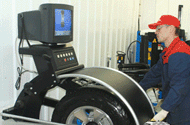 How to choose a tyre fitter?Oh, there’s a shed 300 metres away, what’s there to choose, plenty of motorists will say. And they’ll be wrong: a tyre fitter, and for that matter the fitter you trust with your wheels, needs to be…
Inspecting tyres before you buy themPatches, retread marks and other traces of a tyre being “treated” for various kinds of damage at the tyre fitter’s: what can they tell you?
Run-flat tyres: repairabilityCan run-flat tyres be repaired? A puncture in the tread is no problem, but after a sidewall cut such a tyre definitely goes to the scrap heap.
How to choose a tyre fitter?Oh, there’s a shed 300 metres away, what’s there to choose, plenty of motorists will say. And they’ll be wrong: a tyre fitter, and for that matter the fitter you trust with your wheels, needs to be…
Inspecting tyres before you buy themPatches, retread marks and other traces of a tyre being “treated” for various kinds of damage at the tyre fitter’s: what can they tell you?
Run-flat tyres: repairabilityCan run-flat tyres be repaired? A puncture in the tread is no problem, but after a sidewall cut such a tyre definitely goes to the scrap heap.