What affects the quality of wheel balancing

Equipment or the human factor?
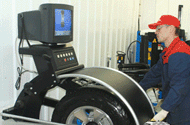
What has more effect on the outcome of wheel balancing, the balancing machine or the fitter’s skill? On the whole, both matter in roughly equal measure. Experienced tyre fitters say that you can balance anything “down to zero”, but that alone does not mean the wheel will be fit to use safely for its purpose.
While you can at least judge a fitter’s skill (and attitude to the job) from indirect signs, you sadly cannot judge the accuracy and condition (calibration) of the balancing machine at all. So try to avoid having your wheels balanced at unfamiliar “roadside” tyre-repair shops: you will end up having that balancing checked again later anyway.
So what should good-quality wheel balancing look like?
- There is no point balancing a dirty wheel, with lumps of dirt stuck to the inner surfaces of the wheel and stones wedged in the tread, so at a good tyre fitter’s the wheel is thoroughly cleaned of dirt and stones, and of any previously fitted balance weights, before balancing.
- Before balancing it is well worth measuring (and not “by eye”, but exact figures) the runout of the wheel and the tyre (radial and lateral).
- A balancing machine will not show any accurate measurements at all if it is coated in a thick layer of dirt.
Not so long ago, fundamentally new machines started appearing at modern tyre centres, popularly known as 3D tyre fitting. This equipment uses laser diagnostics to work out the precise geometry of the wheel on its own and of the complete wheel assembly (runout included), and to position the tyre on the wheel in the most effective way, giving the best possible mutual compensation between the wheel’s and the tyre’s imbalance. This kind of equipment is undoubtedly a serious step forward for wheel balancing, but for now, sadly, it remains extremely hard to find at tyre centres, even in big cities.
 How to choose a tyre fitter?Oh, there’s a shed 300 metres away, what’s there to choose, plenty of motorists will say. And they’ll be wrong: a tyre fitter, and for that matter the fitter you trust with your wheels, needs to be…
Beware the impact wrench!It seems such a routine procedure: doing up bolts with an air gun. Most motorists are used to this step and pay it no attention at all.
Alloy wheel repairAt first glance the question is simple, since the answer to it is right there on the signs outside most tyre-fitting workshops. If alloy wheels are repaired, that must mean it’s allowed?
A punctured tyre: what can be repaired and what cannot“A string plug from outside, five minutes and off we go,” promises the roadside tyre fitter, and the wheel is not even taken off the car. Quick, cheap, and the tyre seems to hold air.
How to choose a tyre fitter?Oh, there’s a shed 300 metres away, what’s there to choose, plenty of motorists will say. And they’ll be wrong: a tyre fitter, and for that matter the fitter you trust with your wheels, needs to be…
Beware the impact wrench!It seems such a routine procedure: doing up bolts with an air gun. Most motorists are used to this step and pay it no attention at all.
Alloy wheel repairAt first glance the question is simple, since the answer to it is right there on the signs outside most tyre-fitting workshops. If alloy wheels are repaired, that must mean it’s allowed?
A punctured tyre: what can be repaired and what cannot“A string plug from outside, five minutes and off we go,” promises the roadside tyre fitter, and the wheel is not even taken off the car. Quick, cheap, and the tyre seems to hold air.