Inspecting tyres before you buy them
Patches, retread marks and other traces of a tyre being “treated” for various kinds of damage at the tyre fitter’s: what can they tell you? They will genuinely help you decide whether or not this tyre is worth buying.

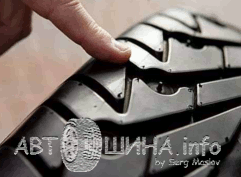
At most modern tyre-fitting shops they will be able to restore a car tyre after practically any kind of damage, but only some kinds of repair leave a tyre fit for further safe use as intended. So before buying part-worn tyres you first need to correctly judge the extent and nature of tread wear (more on tyre tread wear), and second, inspect each tyre carefully and assess the state of the tyre itself, whether there has been any serious damage and (if so) how it was fixed.
It is best to inspect a tyre in two stages: first look it over carefully, off the wheel, from the outside and the inside (a magnifying glass is a good idea), and then, at the tyre-fitting shop, fit it onto a wheel (a known true one), pump it up to a higher pressure than the car’s owner’s handbook specifies, balance it and check for runout (lateral or radial, and also any possible bulges). If the number of balance weights needed to balance it is within the normal range, there is no runout or bulging, and the tyre’s surface is fine, the tyre can be taken. There is still a risk that you do not yet know everything bad about this tyre, but it is minimal.
Here are the points that deserve particular attention:
1. Patches on the inside of the tread. Punctures in the tread area are not, in principle, considered especially serious damage, and are fairly effectively “treated” with small patches. If there are not too many of them (no more than 2 per wheel), the tyre is still perfectly fit for use, but you need to be ready for a higher mass of balance weights needed to balance the wheel. If, however, a patch is large (more than a third of the tyre’s width), that may mean a more serious problem is hidden underneath it than a simple puncture.
2. Patches on the inside of the sidewall and/or welding marks on the outside. Under the rules for using radial tyres, any damage to the sidewall (the carcass) of a tyre is deemed incompatible with further use. Whatever roadside fitters tell you, sidewall cuts in radial tyres cannot be repaired! Not ever, and not under any circumstances. Not for the front axle, not for the rear, not for summer, not for winter. So buying a radial tyre with signs of sidewall repair is categorically not recommended, even if the repair looks like it was minor, except perhaps as a spare wheel, and even then with the understanding that this tyre is no longer fit for long distances (more on sidewall cuts in tyres).
3. Traces of a special vulcanising paste (sealant) on the inside of the tyre. In fact, products like this, for all their apparent convenience, are far from always effective and can spoil a tyre. The layer of sealant that forms on the inside of the tyre is uneven, which creates an imbalance that cannot always be removed with balance weights. And washing the paste off the tyre is a practically hopeless task. Either way, you are guaranteed problems with fitting and balancing a tyre like this. Whether you need that or not is for you to decide, depending on the price.
4. Micro-cracks on the inside or outside of the tyre’s sidewalls. Most likely, the rules for storing the tyre were broken, or the tyre is simply too old. A tyre like this may last anywhere from two days to a year, and it can burst at any moment, including at speed: you are definitely better off not buying a tyre like this.
5. Bulging and/or runout in the tyre. When spinning on the wheel balancer there should be no runout at all, none! Neither lateral nor radial. Any unevenness creates runout in the wheel, and it cannot be removed at a tyre-fitting shop, while driving on a tyre like this is dangerous and expensive, because there is a high risk of the wheel suddenly failing or of damage to the car’s suspension. So a tyre with a bulge or runout is only fit for a flower bed or the scrapheap: there is no way to use it on a car, unfortunately. And whatever they tell you, no fitter is able to restore this tyre’s original characteristics.