Where do people usually buy part-worn tyres?
Where and how to buy part-worn tyres: small ads, acquaintances, breakers’ yards or a market, and what to check before you buy used tyres.

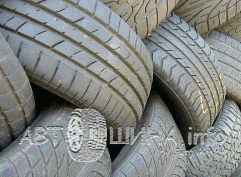
There are plenty of ways: adverts in newspapers and magazines, on specialist regional classifieds sites online, buying from friends, acquaintances and colleagues, or through your favourite car forum. Buying part-worn tyres at a breaker’s yard or at the car market is a category of its own.
Buying tyres from someone you know is certainly safer, because you are more likely to find out the truth (or at least part of it) about the tyres’ past. But even then you need to understand that, first, not every motorist has a deep enough understanding of how car tyres are used, and second, even someone you know well will most likely not tell you everything they know when selling you tyres, and they may not know everything anyway. After all, they are interested in selling, aren’t they?
So even when you buy tyres from a motorist you know well, a professional check at a good tyre fitter’s before you buy is essential! And it needs to be done in daylight, without rushing. In every situation you need to remember that tyres are the single most important safety component, which makes buying them a very responsible undertaking.
Before you arrange to view tyres that have caught your interest, be sure to check a few points with the seller:
1. The reason for selling. This is actually a crucial point. If a motorist is changing tyres mid-season, while the old ones still look perfectly fit for use from the outside, there is a good chance the tyres have hidden defects the owner knows about. So it is entirely natural to ask why the seller has decided to get rid of these tyres. None of this, of course, applies to dealers, that is, to traders for whom buying and selling part-worn tyres is a business.
2. The age of each tyre. The date of manufacture is marked on the tyre’s sidewall, and if the dates on the two tyres of a pair do not match, these tyres were most likely used on different cars or axles. A possible consequence of this is a different degree of wear, both of the tread and of the rubber compound the tyres are made from: such a pair is unlikely to last long together.
3. The repair history. Ask straight away what repairs the tyres have had. If it is about punctures in the tread area, the tyres can be taken for a check; but if a cut in the sidewall has been repaired, the tyre is already definitely unfit for further use, and it is not worth buying, however “minor” the seller says the cut or puncture was.
4. Price and tyre wear. Experience shows that it makes no sense to buy tyres with more than 50% wear (more on how tread wear is correctly worked out) for any money at all. If the wear does not exceed half the tyre’s service life, you need to look carefully at current offers on the new-tyre market and decide whether the game is worth the candle. Buying new tyres in a lower price bracket may well be the sensible choice in a situation like this.
 How to choose a tyre fitter?Oh, there’s a shed 300 metres away, what’s there to choose, plenty of motorists will say. And they’ll be wrong: a tyre fitter, and for that matter the fitter you trust with your wheels, needs to be…
Real tread wear on a tyreIt looks like a simple question: what is the wear (in per cent) on a tyre with a tread block height of 4 mm? In cases like this sellers usually write a “modest” 30%, but what is the truth?
Asymmetric treadAsymmetric winter tread: how its outer and inner halves work, and whether it is a good alternative to a classic winter tyre.
How does a winter tyre differ from a summer one?Most drivers think winter and summer tyres differ mainly in tread pattern. In fact, the key difference is how the rubber handles temperature.
How to choose a tyre fitter?Oh, there’s a shed 300 metres away, what’s there to choose, plenty of motorists will say. And they’ll be wrong: a tyre fitter, and for that matter the fitter you trust with your wheels, needs to be…
Real tread wear on a tyreIt looks like a simple question: what is the wear (in per cent) on a tyre with a tread block height of 4 mm? In cases like this sellers usually write a “modest” 30%, but what is the truth?
Asymmetric treadAsymmetric winter tread: how its outer and inner halves work, and whether it is a good alternative to a classic winter tyre.
How does a winter tyre differ from a summer one?Most drivers think winter and summer tyres differ mainly in tread pattern. In fact, the key difference is how the rubber handles temperature.