Snowflake, mountain or M+S: what the winter marks on a tyre mean
“See the snowflake? Then it’s a winter tyre,” the sales assistant will tell you, and they may even be right.

On car forums the same story comes back with the first frosts. Someone buys “winter” tyres because M+S is written on the sidewall, and in the very first snowfall finds that the car holds the road quite differently from what the seller promised. And the article on the season rating of tyres mentions the snowflake only briefly: it points to a winter tyre, full stop. Let’s put that right, because a good deal has changed here in recent years.
Only one mark on a tyre sidewall confirms a snow test, the mountain with three peaks and a snowflake inside (3PMSF), while M+S, a snowflake drawn on its own or the word Winter are just the manufacturer’s words, which nobody has checked.
What does M+S really mean?
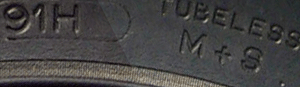
M+S (or M&S) stands for Mud and Snow. The UNECE regulations explain the mark cautiously: it goes on a tyre whose tread pattern or construction is designed so that it grips better than an ordinary tyre in mud and snow. The key word here is “designed”. Nobody measures how much better: the manufacturer applies the mark itself with no test at all, and one of the largest tyre makers writes that the performance of M+S is “not defined and not measured”.
That is why M+S appears on winter and all-season tyres, and even on summer “off-road” ones (more on markings). And the main thing that makes a tyre a winter one, a rubber compound that does not go hard in frost, is something those two letters do not guarantee in any way.
Now about the law, which in some countries is still lenient. In Ukraine, for example, the rules for the technical operation of wheels and tyres (Order No. 549 of the Ministry of Infrastructure) define a winter tyre through this mark: a tyre marked “M+S” (or one of its variants) that the manufacturer has intended for the winter season. Formally that mark is enough, and nobody asks you for the mountain with a snowflake. The rules define what a tyre is called, not how it brakes on snow.
The mountain with three peaks and a snowflake
Quite another matter is the mark that UN Regulation No. 117 officially calls the “Alpine symbol”: the outline of a mountain with three peaks and a snowflake inside (3PMSF, from Three Peak Mountain Snowflake). The manufacturer may apply it only after a test: the tyre is compared with a reference tyre on packed snow, by braking or by traction. A passenger-car tyre has to perform 7-10% better than the reference, depending on the method.
Is that a lot or a little, you ask? Not much: the mark means “meets the minimum”, not “the best winter tyre”. But it is a measured minimum, while M+S has no minimum at all. The difference is roughly that between the line “I can swim” on a form and a certificate saying you really did swim the pool. Why does measuring matter more than describing? Simply because grip on snow depends at once on the tread pattern, the sipes and the softness of the rubber in the cold, and only a test shows how all of that works together.
And what about a snowflake drawn on its own, or the word Winter? As a mark of a passed snow test, the UN rules and the EU regulation describe only the mountain with a snowflake (ice has a separate mark). Everything else is sidewall decoration at the manufacturer’s discretion.
In Germany this has been made law: tyres made from 2018 onwards must carry 3PMSF to count as winter tyres, and on 1 October 2024 the grace period for older tyres with M+S alone ended too. For how it works in other countries, see the article on winter tyres and the law. Incidentally, quite a few all-season tyres carry 3PMSF as well, but the mark speaks only about snow.
And what does the ice mark mean?
Since 1 May 2021 (Regulation (EU) 2020/740) the European tyre label has had two “winter” pictograms: that same mountain with a snowflake, and an ice mark for tyres tested on ice. Now the ice mark is in the UN rules as well: it goes on the sidewall of a passenger-car tyre that already has the mountain with a snowflake and has additionally passed a braking test on ice.
You might think the ice mark means “an even better winter tyre”. It does not. The official information sheet for the label says it outright: such tyres are for ice and packed snow and only for very severe climates, and in a milder one they may lose out in wet grip, handling and wear resistance. The ice mark means a tyre for the real north, and for an ordinary Central European winter with its thaws and wet tarmac you most likely do not need it.
How do you read these marks in a shop?
When I choose winter tyres myself, I look at the sidewall first and only then at the price, and I advise you to do the same:
1. Look for the mountain with a snowflake on the sidewall itself, not only on the sticker: the sticker will come off at the very first fitting, while the sidewall stays.
2. Check the sidewall against the label. If the sidewall has 3PMSF, the label should show the snow pictogram (studded tyres have no label); a mismatch is a reason to question the seller.
3. M+S on its own is not yet a winter tyre, whatever the seller says and however some countries’ technical rules may call it.
4. The ice mark only if your winter is truly severe: plenty of ice and packed snow and few thaws.
To sum up: choose winter tyres by the mountain with three peaks and a snowflake on the sidewall, and treat M+S merely as the manufacturer’s statement about tread pattern and construction. The rules of many countries do not demand that of you, but snow on the road, unfortunately, does not read the rules.
All the articles in this section: Tyre markings
Question and answer
- Can a tyre marked M+S be considered a winter tyre?
- In some countries, formally, yes: Ukraine’s technical rules, for example, call a tyre marked M+S a winter tyre if the manufacturer intended it for winter. But manufacturers apply M+S themselves, untested. Only the mountain with three peaks and a snowflake (3PMSF) confirms a snow test, so M+S alone is not a winter tyre.
 Speed rating, load index, and tyre season markings againA tyre’s speed rating and load index are figures you must pay attention to when buying. The speed rating limits your maximum speed, and the load index shows the maximum weight of the car that can…
Season markings on tyresAs a rule, a tyre’s sidewall always shows which season, weather or road surface it is meant for. Interestingly, many motorists still believe that the M+S (M&S) marking means a tyre is a winter one…
The European tyre label: what is on it and what is notMany people take the sticker on the tread for the result of an independent test: class A means the best tyre. In fact the label gives the classes of just three parameters of a new tyre, measured by a…
All-season tyres today: who they really suit“A modern all-season is no longer a compromise: fit it once and forget the way to the tyre fitter,” the salesmen assure us.
Winter tyres and the law: Ukraine, Bulgaria, Poland and neighboursEvery autumn someone on a car forum is sure to demand: “show me the law that makes me fit winter tyres!” In Ukraine there really is no such law.
How does a winter tyre differ from a summer one?Most drivers think winter and summer tyres differ mainly in tread pattern. In fact, the key difference is how the rubber handles temperature.
Speed rating, load index, and tyre season markings againA tyre’s speed rating and load index are figures you must pay attention to when buying. The speed rating limits your maximum speed, and the load index shows the maximum weight of the car that can…
Season markings on tyresAs a rule, a tyre’s sidewall always shows which season, weather or road surface it is meant for. Interestingly, many motorists still believe that the M+S (M&S) marking means a tyre is a winter one…
The European tyre label: what is on it and what is notMany people take the sticker on the tread for the result of an independent test: class A means the best tyre. In fact the label gives the classes of just three parameters of a new tyre, measured by a…
All-season tyres today: who they really suit“A modern all-season is no longer a compromise: fit it once and forget the way to the tyre fitter,” the salesmen assure us.
Winter tyres and the law: Ukraine, Bulgaria, Poland and neighboursEvery autumn someone on a car forum is sure to demand: “show me the law that makes me fit winter tyres!” In Ukraine there really is no such law.
How does a winter tyre differ from a summer one?Most drivers think winter and summer tyres differ mainly in tread pattern. In fact, the key difference is how the rubber handles temperature.
See also
In this section
 Tyre sizeTyre size is probably the most easily understood parameter for most motorists. That said, not everyone realises that keeping to the size the car maker specifies is essential for safe driving.
Date of manufacture of a tyreWhen buying new tyres, you must always check the date of manufacture of each one. Sadly, buyers, especially in Eastern Europe, are often sold last year’s tyres (if not older) at the price of new…
Rules for fitting a tyre to a wheelMany modern tyres have a directional tread pattern; some tyres also need to go on with a particular sidewall facing outwards, and some can only be fitted on the left or right side of the car.
Coloured marks on tyresOn practically any new tyre, besides the standard moulded markings, you can also see marks (stripes) applied in coloured paint.
Retreaded tyres (Retread)Retreaded tyres are on the market too, if not in large numbers. At first glance the offer looks very tempting: for the price of a fairly worn tyre you can buy...
How many years can a tyre last: 5, 7 or 10?A car-forum “axiom” has been going round for years: a tyre lives five years and then goes to the tip. Sellers of new sets, of course, like it.
Tyre sizeTyre size is probably the most easily understood parameter for most motorists. That said, not everyone realises that keeping to the size the car maker specifies is essential for safe driving.
Date of manufacture of a tyreWhen buying new tyres, you must always check the date of manufacture of each one. Sadly, buyers, especially in Eastern Europe, are often sold last year’s tyres (if not older) at the price of new…
Rules for fitting a tyre to a wheelMany modern tyres have a directional tread pattern; some tyres also need to go on with a particular sidewall facing outwards, and some can only be fitted on the left or right side of the car.
Coloured marks on tyresOn practically any new tyre, besides the standard moulded markings, you can also see marks (stripes) applied in coloured paint.
Retreaded tyres (Retread)Retreaded tyres are on the market too, if not in large numbers. At first glance the offer looks very tempting: for the price of a fairly worn tyre you can buy...
How many years can a tyre last: 5, 7 or 10?A car-forum “axiom” has been going round for years: a tyre lives five years and then goes to the tip. Sellers of new sets, of course, like it.