Retreaded tyres (Retread)
Retreaded tyres are on the market too, if not in large numbers. At first glance the offer looks very tempting: for the price of a fairly worn tyre you can buy...

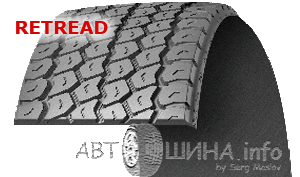
Retreaded tyres (Retread)
Many countries have companies that retread tyres with worn tread. Even some leading tyre makers have subsidiaries that carry out this kind of production. As a result, retreaded tyres reach the market, tempting thrifty motorists with their price, which is lower than that of new tyres. How sensible and how safe is it to use such tyres?
How do you identify a retreaded tyre?
Unless it is a straightforward knock-off of a well-known maker, a retreaded tyre’s sidewall must carry a marking indicating the tyre’s “second life”. This is usually Retread (the universal marking), Remould (the British variant), Regummerad (the Swedish variant), or the equivalent word in the language of the country where the tyre was retreaded.
What is more, the markings on the sidewalls of retreaded tyres are usually blurred, and the inner surface of such tyres is usually coated with a thin layer of a mix of carbon black and rubber crumb (a feature of the retreading technology). There can also be other signs - a network of hairline cracks on the sidewall that was not touched during retreading, bulges of rubber on the inner surfaces left over from puncture repairs, and so on. In any case, on close inspection a retreaded tyre is not at all hard to identify, especially if you can compare it with a new one.
What gets retreaded?
When retreading, a new tread, and in many cases a new sidewall, is bonded onto the worn tyre. In doing so, the tyre’s carcass, belt and other structural parts are kept from the old tyre. Overall, in essence, retreading is a cosmetic, external repair of the tyre. What is more, the tread pattern applied during retreading does not always match the one originally moulded onto the tyre. On top of that, the same tread is bonded onto different tyres, often even from different makers. A natural consequence of this is that nobody can guarantee that two retreaded tyres with the same tread pattern (on the outside) will actually perform the same.
That is exactly why retreaded tyres always have reduced ratings, both for speed and for load index. That covers the ratings printed on the sidewall of a retreaded tyre. It is much harder with the characteristics that cannot be printed on a tyre - the difference between two outwardly identical retreaded tyres that you fit to one axle of the car. How can they differ? In weight, in carcass stiffness, in operating temperature range and in many other parameters. And all these “minor” parameters have a great deal of influence on the car’s directional stability, as well as on how it behaves in extreme conditions.
When does a retreaded tyre make sense?
Buy cheap, buy twice - always remember that. But if you never speed and never drive aggressively behind the wheel, and if you very rarely leave your city, then in principle you can probably consider buying retreaded tyres. Just bear in mind that buying retreaded tyres is, in any case, a lottery. Such tyres are usually bought for taxis or commercial vehicles, and whether you can afford such tyres is for you to decide. In any case, saving money on tyres is a fairly questionable move, even though retreading tyres is part of environmental protection programmes.