Coloured marks on tyres
On practically any new tyre, besides the standard moulded markings, you can also see marks (stripes) applied in coloured paint. The paint wears off quickly, so motorists want to know: what does this coloured marking tell the consumer, and should you pay attention to it when buying tyres?

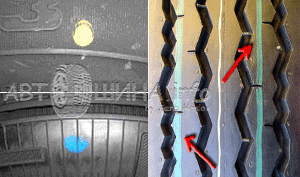
Online you can find plenty of theories about where the coloured marks on new tyres come from, ranging from the idea that all coloured marks are purely technological and mean nothing at all to the end consumer, to the idea that tyre makers use coloured marks to flag faulty goods and/or goods that failed final quality control. Where is the truth?
In fact, logic suggests that, by applying any mark to a tyre in paint that will sooner or later wear off (or wash off), the tyre maker assumes that the information the mark carries is only relevant for a while - say, until the tyre is first fitted to a wheel. That is the starting point to work from.
There are three main types of coloured mark applied in paint to the surface of a tyre:
- Coloured round dots 5-10 mm in diameter, applied to the outer sidewall of the tyre, closer to the wheel rim. These dots can be yellow, red, green, white and so on.
Depending on the colour and the specific tyre maker, these dots carry different information. A yellow dot usually marks the lightest point on the tyre. When the tyre is first fitted, it is recommended to line this dot up with the wheel’s valve - that way the complete wheel will be better balanced and will need fewer balance weights. Obviously, the difference in weight between different parts of a good new tyre is tiny, and this mark stops being relevant after the very first emergency braking, so there is no need to look for it from the second tyre fitting onwards.
Marks of any other colour either carry a similar kind of meaning (for example, a red dot usually marks the point of greatest force variation in the tyre, which is recommended to be lined up with the “lowest” point of the rim marked on the wheel), or are meant for use when a tyre is first fitted to a new car on the production line, so they have practically no value for either the consumer or the tyre fitter.
- A digit (number) inside a triangle (square, circle, diamond), applied, usually in white paint, also to the outer sidewall of the tyre.
This is a mark entirely equivalent to the old Soviet quality-control stamp. An employee of the tyre factory carries out final quality control of the finished product and applies this stamp, which serves two purposes: first, it shows that the check has been done, and second, it identifies the specific inspector responsible for the quality of that final check. Unless you work at a factory that makes tyres, this stamp means absolutely nothing to you.
- Coloured stripes running around the tyre in the tread area, either on the tread itself or inside the grooves.
It is precisely these mysterious stripes that give rise to various rumours suggesting they might indicate faulty or substandard goods. In reality it is all perfectly mundane - the stripes are applied purely to allow quick identification of different tyre models and sizes in warehouses, where, given how tyres are stored, a warehouse worker can usually only see the tread area.