Spigot rings for wheels: everything you need to know
Spigot rings (hub-centric rings) for wheels: some say they are unnecessary, others that they are essential. Why you may need them and how to choose them.

The question 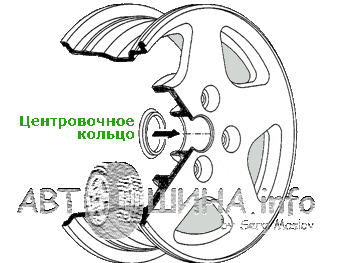 of spigot rings usually comes up when a car owner plans to fit non-standard wheels (that is, wheels not directly specified by the car maker for that particular car), some of whose figures (in particular the centre bore) do not quite match those of the standard wheels. No end of arguments rage online about how critical this figure (DIA) really is, whether spigot rings are needed at all, and which rings are the better choice. Let’s try to work it all out.
Before talking about whether spigot rings are needed, and how to choose the right ones, it is worth recalling what a centre bore on a wheel is actually for. Many sellers, and even mechanics, do not entirely understand (or simply do not mention) how important it is for a wheel’s figures to match the hub’s figures exactly, usually because it simply suits them not to. All the same, the question is a serious one and deserves a clear answer from any motorist, since it directly affects road safety.
For the lazy and the busy: the gist of this article is that a wheel’s centre bore must exactly match the size of the hub’s spigot, and there can be no tolerances or “acceptable deviations” here at all. If you want to fit a wheel whose centre bore is bigger than the diameter of the hub’s spigot, you will need to stock up on spigot rings, and with a good supply at that, since you will most likely have to replace them fairly often, whatever they are made from.