How worn is the tyre?
Most often it is the remaining tread that is considered the most important parameter of a part-worn tyre, but how informative is that measurement really? In fact, for different types of car tyre the same remaining tread depth can hand down diametrically opposite “verdicts” - anywhere from “this tyre still has a few seasons left in it” to “this tyre is already unfit for use”.

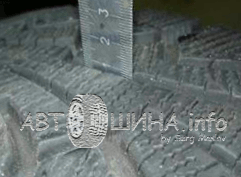
The most common criterion used to set the price and gauge the consumer appeal of part-worn tyres is tread depth. Depth certainly matters, but you also need to understand that different tyres start out with different tread depths (when they are new), and, more importantly, different tyres have a different wear limit (the tread depth at which a tyre has already lost practically all of its important characteristics). These differences are most noticeable between winter and summer tyres.
Take two tyres as an example: one a high-speed summer rain tyre, the other a winter tyre with a Nordic tread pattern. The material summer tyres are made from is substantially harder than the rubber used for winter tyres, and besides (unless we are talking about a summer off-road tyre), tread depth matters far more for winter tyres in terms of the ability to “bite” into ground covered by a layer of snow. What is more, when driving at high speed on tarmac, a deep tread is more of a hindrance than a help.
Given these differences, a high-speed summer tyre starts out with a tread depth of 6-8 mm, while a winter tyre with a Nordic tread pattern usually starts at 9-11 mm. It follows that, all else being equal, a winter tyre will wear faster than a summer one, because of its softer rubber and the smaller outer surface area of the tread blocks (which increases the load per unit of that area in terms of wear).
From a safety point of view, in the most typical seasonal conditions (dry, hard road surface), what matters most for winter tyres is the presence and quality of the lateral sipes in the tread blocks (drivers call them “Velcro”, and they cut braking distance and improve directional stability). For a summer tyre, on the other hand, what matters most is simply how much tread is left, since once it drops below a certain level it will just reduce the tyre’s ability to resist aquaplaning.
If we rule out extreme driving from the possible conditions a car will meet (and when weighing up whether to buy part-worn tyres you will have to rule it out anyway), and also take into account that the lateral sipes on winter tyres cannot, for technical reasons, be cut all the way down to the base of the tread and are usually 4-5 mm deep, then what is left boils down to this: while a summer tyre with 50% wear can still be regarded as usable for a while longer, a winter tyre with 50% wear and 5-6 mm of tread depth, but with worn-away sipes, is in practice already unfit for safe use in winter conditions, despite having a greater tread depth than the summer tyre.