Uneven tread wear on a tyre
A proper check of part-worn tyres before you buy will help you work out how evenly the tread has worn across its full width. When making the final decision to buy, it is important to understand what uneven tread wear tells you, and what the causes and consequences of such wear are.

What does uneven tread wear tell you?
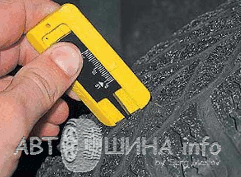
How do you correctly measure tyre tread depth? It is not difficult, and any suitable tool will do the job: a vernier calliper or a ruler with a depth gauge, for example. You can, of course, use an ordinary coin, but in that case the accuracy of the measurement will suffer badly, and you will not get a reliable picture of how even the wear is, which matters quite a lot.
First of all, tread depth needs to be measured at a minimum of 6 different points (better still, 9 or even 12), at the centre and both edges of the tread, at different points around the tyre’s circumference. The measurements at every one of these points should match! Uneven wear tells you the following:
-
The tread is higher at the edges than in the centre. This points to excessive frugality on the previous owner’s part: the tyre was over-inflated for a long time. As a result the load on the tyre’s carcass was increased, which clearly could not help but affect the tyre’s overall service life. Buying a tyre like this is not recommended.
-
The tread is higher in the centre than at the edges. The tyre was consistently under-inflated. If there is no obvious sign of driving on a completely flat tyre (the pattern worn away from the top of the sidewalls), you can most likely still drive on this tyre, but you need to work out the wear from the lowest tread-depth figure, because at normal pressure the centre of the tyre wears down to the level of the edges very quickly.
-
The tread is worn unevenly across its width (one edge of the tyre is worn away). Wear like this points to a fault in the car’s suspension (camber needs adjusting). Once you fit a tyre like this to a car with a healthy suspension, for a while the tyre will have very poor grip on the road surface, until the wear “evens out” across the tyre’s full width. That should happen fairly quickly, but during that period you will need to be extremely careful: both directional stability and braking distance will suffer badly. Either way, wear on a tyre like this is counted from the lowest tread depth.
-
The tread is worn unevenly around the wheel’s circumference (the centre or side tread blocks have a different height at different points around the circumference). Wear like this points to the previous owner’s taste for “extreme” driving. The tyre has most likely seen extreme braking and/or hard acceleration. As a result, this kind of use significantly changed the tyre’s temperature regime, which could have affected the structure and condition of the rubber and the tyre’s carcass (its overall service life). What is more, a tyre with an uneven tread depth around its circumference will inevitably have a force variation (one that cannot be identified or corrected on an ordinary tyre fitter’s wheel balancer), which will affect the car’s safety and the state of its suspension for the worse. You can safely scrap this tyre.
-
The pattern worn away at the top of the tyre’s sidewall (where it meets the tread area - the rubber looks “chewed up”). A defect like this is the result of driving for a long time on a badly deflated tyre. As a rule this damages the load-bearing part of the tyre’s carcass, and the tyre develops severe runout that cannot be fixed with balance weights at the tyre fitter’s. A tyre like this will usually be very noisy and will put several times the normal load on the wheel bearing. You obviously cannot buy a tyre like this, whatever the seller says.
-
Different tread wear on the two tyres of a pair (from one axle). Here the first thing to check is the date of manufacture of the tyres, and also the batch number, if it is given. If the dates are different, this pair of tyres was most likely put together from “spares”. Whether they are worth buying is for you to decide. If the dates match, a faulty suspension (toe needing adjustment) is likely. Either way, a difference in tread depth of more than 1 mm is already a serious risk of an uncontrolled skid, if that pair of wheels is fitted to the car’s front axle.
-
Back to the section: everything about buying part-worn tyres