All-season tyres today: who they really suit
“A modern all-season is no longer a compromise: fit it once and forget the way to the tyre fitter,” the salesmen assure us. There is some truth in that: all-season tyres really have changed in recent years.

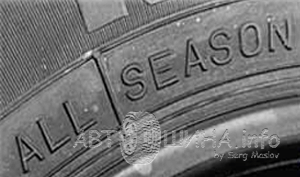
In the article on all-season tyres the verdict was harsh: “all-season” positioning in practice means “between-seasons”, and the most you can do with such a tyre is fit it for a few weeks of late autumn and early spring. That was true of the tyres of the time, and for many of today’s it still is. But since then something new has appeared in this class, and that has to be admitted. A modern all-season tyre with the snowflake is a perfectly reasonable choice for the whole year, but by no means for every driver or every corner of Europe.
What has changed in all-season tyres?
It used to be that everything “winter” about an all-season tyre came down to the words All Season and M+S. The M+S mark is only the manufacturer’s claim about the tread pattern, with no test behind it.
Modern all-season tyres increasingly carry one more mark on the sidewall: a mountain with three peaks and a snowflake (3PMSF). It cannot be added just like that: the tyre has to pass a standardised snow test under UN Regulation No. 117 and show better grip than a reference tyre. In Europe demand for all-seasons is growing faster than for any other kind of tyre, and in Germany, since 1 October 2024, only a tyre with the snowflake counts as a winter tyre; an all-season qualifies too, if it carries the mark.
Other countries are less demanding. In Ukraine, for example, the “Rules for the Technical Operation of Wheels and Pneumatic Tyres…”, approved in 2013 by Order No. 549 of the Ministry of Infrastructure, require winter or all-season tyres on passenger cars in the winter season (clause 20), and summer or all-season ones in the summer season (clause 35). They define a winter tyre as one marked M+S and intended by the manufacturer for winter, and an all-season tyre as one marked All Seasons, and they require no snow test at all (for a comparison with the rules of neighbouring countries, see the article on winter tyres and the law). For the law, an old “between-seasons” tyre and a new one with the snowflake are one and the same. For physics, not at all.
Why the compromise has not gone away
The snowflake is a big step forward, but let’s not confuse snow with ice. The 3PMSF mark proves that the tyre grips decently on snow, and nothing more. Ice is not tested in that procedure, and July heat certainly is not. For ice, the European label under Regulation (EU) 2020/740 has a separate pictogram with its own test.
Remember the eraser that goes hard in the frost? A summer compound begins to stiffen already at temperatures below +7 °C, which is where the 5-7 °C rule for switching to winter tyres comes from. A winter compound, on the contrary, goes soft and “melts” in warm weather. An all-season sits in the middle: the compound is softer than a summer tyre’s, there are more sipes and the grooves are deeper. One of the largest tyre makers writes that all-seasons are designed for a range of roughly -10 to +30 °C. Now think of an Eastern European January with frosts down to -15 °C and an August with heat up to +35 °C in the shade.
An all-season tyre is like trainers for the whole year. You can walk in them in July and in January. But running over ice or red-hot tarmac with a full rucksack is a different matter altogether. In heat and under load the softer tread blocks, cut up by sipes, usually deform more than those of a summer tyre; the braking distance grows and wear speeds up. Independent comparison tests also show a huge spread between models: the best in moderate conditions are barely behind the “specialists”, while the worst are simply dangerous. And in extreme conditions (heat with a full boot, deep snow, ice) summer and winter tyres remain the better choice.
Who an all-season tyre suits
A mechanic I know hears the same thing every autumn: “I’ve got all-seasons, so do I have to change anything?” The answer depends less on the tyre than on where and how you drive. A tyre with the snowflake is a sensible choice if most of the points on this list describe you:
- You drive mostly around the city, on streets that are cleared regularly (snow there is a guest for a day or two, not the master of the house for a month).
- The winters in your region are mild, above all in southern and coastal regions, where hard frosts are rare and snow usually does not lie long.
- Your mileage is low. Then the tyre wears out before it has time to age; two sets more often go on the scrap heap because of age than because of wear.
- You have nowhere to keep a second set, and you begrudge paying for tyre storage every season.
- You can stay at home when there is black ice or heavy snow on the road: for you the car is not the breadwinner.
Who it does not suit
And here is who needs more than one set, whatever the sales assistant says:
- The Alps, the Carpathians and other mountain roads, and also the north with its long snowy winters.
- Country and out-of-town roads that nobody clears: slush, ruts, ice under the snow. That is exactly where the compromise ends.
- The car is your breadwinner, and you have to drive in any weather.
- High mileage and long summer trips on the open road in the heat with a full boot: here an all-season tyre is at its limit.
- You need a margin of safety when braking on ice. The snowflake does not guarantee ice grip, and studs are no way out either: many countries ban them, and the same Ukrainian Rules allow only new winter tyres with factory stud holes to be studded (clause 24).
Here the answer is the same as before: two sets (where to start when choosing winter tyres).
To sum up: the former verdict “all-season = between-seasons” still stands today for tyres without the snowflake. Some countries’ rules (Ukraine’s, for example) allow even such a tyre in winter, but that is a matter of law, not of safety. Fitted in winter, a tyre without the snowflake is still not a winter tyre, whatever is written on its sidewall (German law agrees with me). A modern all-season tyre with the 3PMSF mark is a sensible choice for the whole year for city driving, a mild climate and low mileage, but not a replacement for a winter tyre in the mountains, in the north and on roads that are not cleared. For the city and a mild winter, one set or two is a question of money and convenience, so decide that for yourself. But where ice and snow are the norm, you must not skimp on grip: the miser pays twice, and on ice sometimes not in money.
Question and answer
- Can you drive on all-season tyres all year round?
- You can: in Germany, for example, an all-season tyre with the snowflake mark counts as a winter tyre, and Ukraine’s rules allow all-season tyres in both winter and summer. But it is sensible only for city driving, a mild climate and low mileage, and only with the 3PMSF snowflake. Mountains, the north and uncleared roads need two sets.