Do you need studs?
Do you need studs? Where studded tyres really shorten braking distance and where they reduce grip, and why all four wheels must be studded.

Studs: do you need them or not?
The main thing first: if a car has studded tyres, it has four of them! Two studded wheels on the driven axle with unstudded ones (even a good winter tyre) on the non-driven axle is practically a guaranteed uncontrolled skid under emergency braking on ice or packed snow! The thing is, the difference in grip between studded and unstudded tyres on these surfaces is too great, and the engineers who designed your car worked out the distribution of braking loads on the assumption that the front and rear tyres would be the same.
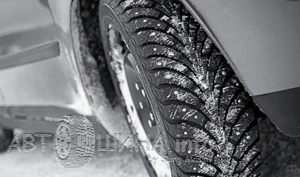
Whether they need studs is something every driver has to decide for themselves. The main thing is not to fall for the mistaken stereotype that studs in winter unconditionally mean more safety. That is true, but only partly. Studs really will shorten your braking distance on well-packed snow and a crust of ice. Correspondingly, they will improve the car’s stability and make pulling away and accelerating easier in those same conditions. But on dry and wet tarmac studs do the opposite: they significantly reduce the wheels’ grip on the road, which in turn significantly lengthens braking distance and reduces resistance to skidding, and in loose snow or on a muddy dirt road studs will get your car “dug in” and “beached on its belly” far faster. Studs are banned outright in many European countries, and that is by no means only out of concern for preserving the road surface.
What is more, many modern studless winter tyres are barely behind studded ones for grip in genuine black ice, especially when the air temperature drops below -15 degrees. This is thanks to the tread structure, which has lateral sipes cut into it (drivers call them “Velcro”).
When thinking about studs, try to remember exactly how many days last winter you actually had genuine black ice under your wheels. If you really do often find yourself holding your breath, watching to see whether your car will stop before the next obstacle, feeling the brake pedal vibrate (if you have ABS), then you probably either really do need studs, or it might be worth rethinking your winter driving style. What is more, studs are more effective for heavy off-roaders and may be worth having for owners of rear-wheel-drive cars on slippery slopes.
Either way, you need to bear in mind that using studs should definitely make you more careful on the road in winter and make you drive more slowly, since a studded tyre’s behaviour on different surfaces is very often completely unpredictable. After all, even black ice is far from always even, and if your car is not fitted with a modern system for evening out driving and braking force at each wheel, studs can cause a skid far faster than tyres without them.