Tyre pressure

What is the optimal tyre pressure?
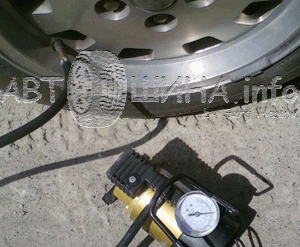
What pressure should you run in your tyres? You should, of course, start from the car maker’s recommendations: the table of tyre pressure values for a given size and the car’s actual load is usually stuck to the fuel filler flap or on the door pillar in the driver’s door opening. In general, the correct answer to the question of tyre pressure is this: you should run exactly what the car maker specifies, no more and no less, and there are plenty of justifications for this rule on the internet, and practically all of them are logical and correct.
That said, the realities of a motorist’s life in Eastern Europe sadly do not always fit this rule, which is sacrosanct in Western Europe, and, in my opinion, tyre pressure can and should be adapted a little to your own particular situation. In particular, if the car is mostly used on city streets with a less than perfect surface, I think it is perfectly acceptable to run your tyres 10-15% “soft” in winter and 5-10% in summer, depending on the state of the roads you normally drive on. In practice that means I run my tyres at the minimum pressure specified for a fully unladen car (and in winter, even a little below that), even though my car often carries passengers and luggage. You should understand that the pressure requirements printed on the fuel filler flap (or on the door pillar in the driver’s door opening) are worked out for use on roads with certain average characteristics. And those characteristics, say in Western Europe or the USA, differ substantially from what you meet on many Eastern European roads. Roads there are often objectively worse. Above all this is about how even the road surface is. And that is especially true in winter, when islands of frozen ice and dirty slush are left on poorly cleared roads.
How do potholes and a “washboard” surface affect tyre pressure, you may ask? After all, tyre and car makers write whole treatises about the premature wear caused by under- and over-inflated tyres, and the harm they do to driving safety?
Yes, that is true. An under-inflated tyre wears faster and behaves less confidently on a smooth road (handling and resistance to skidding). At the same time, in some situations slightly softer tyres can save the car, help you get out of a snowdrift or mud, and substantially extend the life of the car’s suspension. So on less than perfect roads, tyre pressure is, to some extent, a compromise.