Run-flat tyres
In recent years the leading tyre makers have been racing each other to advertise their latest achievement: tyres that are not afraid of punctures. These tyres are called run-flat tyres. Given a whole range of factors, though, this advertising looks more like a false start in a race - the market is not yet ready for a mass takeover by thick-profile tyres.

“Puncture-proof” run-flat tyres
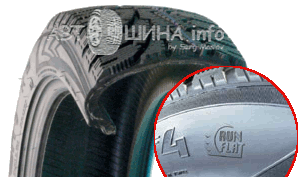
Not so long ago, tyres began appearing on the tyre market that, according to their makers, do away completely with the need for a car’s spare wheel. Is that really true?
In general, the idea of a tyre that is not afraid of punctures has occupied inventors’ imaginations ever since the pneumatic tyre itself was invented (a tyre whose shape is held by the pressure of the air pumped into it), as a concept. It is worth noting that such tyres were invented by Robert Thomson as far back as 1846.
Over the last few decades countless different concepts of a “puncture-proof” tyre have been tried, from a solid construction (which needs no air at all) to filling tyres with a special elastic sealant able to automatically “seal up” small punctures. In the end, though, every tyre maker arrived at the same conclusion: the best way to develop the idea is to reinforce the tyre’s sidewalls - the so-called self-supporting tyre.
It is precisely these tyres that lose comparatively little in performance and, in some cases, really are able to do away with the need for a spare wheel as such. That said, this is only relevant in certain situations for now, and running modern run-flat tyres still comes with a number of nuances that any motorist thinking about buying this novelty absolutely needs to understand.
Articles in this sectionIn reading order.
- What are run-flat tyres?What are run-flat tyres? How they carry the car without pressure, how far and how fast you can go on them, and whether they are safe.137 words
- Run-flat tyres: pressure monitoringRun-flat tyres without a pressure monitoring system: why the driver may not notice a puncture, and what that risks for your wallet and even your life.241 words
- Run-flat tyres: repairabilityCan run-flat tyres be repaired? A puncture in the tread is no problem, but after a sidewall cut such a tyre definitely goes to the scrap heap.86 words
- Run-flat tyres: strengthWill run-flat tyres really last 80 km without pressure? What happens to the sidewalls, and why a tyre can be ruined long before it wears out.121 words
- Run-flat tyres: extra weightRun-flat tyres weigh kilograms more than ordinary ones: how the extra unsprung mass raises the load on the suspension and worsens handling.125 words
- Run-flat tyres: characteristics and stiffnessHow the stiff sidewalls of run-flat tyres affect the car, and why such tyres can only be fitted to cars designed for them.137 words
- Run-flat tyres: road infrastructureRun-flat tyres and road infrastructure: will there be a tyre fitter within 80 km, and why going without a spare is risky in much of Eastern Europe.119 words
- Run-flat tyres: the tyre-fitting problemRun-flat tyres and tyre fitting: why a stiff sidewall is hard to fit onto a wheel, and why most workshops will not repair such a tyre.108 words
- Run-flat tyres: conclusionsRun-flat tyres: conclusions. The two conditions under which “puncture-proof” tyres could become widespread, and how many are already met.180 words