What forces act on suspension parts?
What forces act on suspension parts: taking a MacPherson strut as the example, how wheel offset changes the load on the hub and the arms.

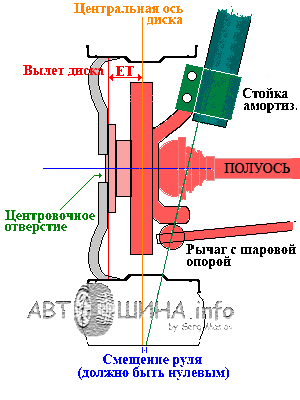
If you broke down a modern car’s suspension by the forces acting on each of its parts, you would end up with a multi-volume work far beyond an ordinary motorist’s grasp. So for the sake of clarity, let’s look at a simplified version of the independent MacPherson strut suspension, where the hub is attached to the body by one transverse arm and a strut with a damper.
By Newton’s third law (the force of action equals the force of reaction), the car’s total mass is shared between its four wheels, and the force acting on each wheel is directed away from the surface the car is standing (or moving) on. The point this force is applied at is the centre of the contact patch where the tyre meets the road surface. If we assume the car’s suspension is sound, the wheels are balanced and the camber and toe angles are within spec, this centre of the contact patch will sit on the wheel’s axis of symmetry across its width. The axis of the damper strut, where the track rod (end) mounting sits, should drop to that same point.
So the force equal to the share of the car’s mass carried by any one of its wheels is directed away from the ground, and the point that force is applied at is the centre of symmetry of the wheel across its width. Given the suspension’s design, this force creates moments on the wheel bearing, the arm (tension) and the strut with the damper (compression).
And the engineer designing the car’s suspension parts carefully calculates all these moments, taking into account, among other things, the hub, the arm, the damper strut, the ball joint and the track rod ends. A safety margin is, of course, built in, but as a rule this margin tends to shrink, since increasing it drives up the cost of the suspension as a whole.