How should you store wheels?
How to store wheels: tyres on or off the wheels, stacked, hung up or standing upright, and what happens to the tyres if you choose the wrong way.

On wheels or separately?
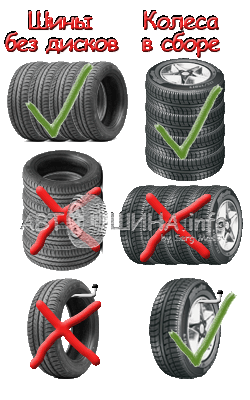
There is no question that it is best to store complete wheels, inflated to the normal pressure (the one you run when the wheels are fitted to the car). First of all, because this way no condensation or dust gets onto the inside surface of the tyres. It is also much more convenient, both when changing tyres for the season and for the storage itself. But not every motorist can afford to buy a second set of wheels, so tyres can be stored separately too.
The diagram on this page is more of a recommendation than a strict rule, because if you are only storing one set of tyres, breaking the rules shown in the diagram is unlikely to lead to any noticeably unpleasant consequences. So stacked, hung up or standing in a row: it is, in principle, up to you to decide what suits you, but there are a few fairly important points you need to understand.
-
If you store tyres without wheels, stacked, this creates uneven pressure on their sidewalls (the greatest pressure on the bottom tyre). It is those two bottom tyres that may then be hard to fit onto a wheel and inflate, if the wheel’s rim width is a little more than the minimum recommended for your tyres’ width.
-
If you store tyres without wheels, hung up, try to make sure the edges of the sidewalls do not rest on a thin bar, because under the tyre’s weight the edge of the tyre can become deformed at that point, which again can lead to problems fitting and inflating the tyres. So in this case wrap something soft around the hook the tyre hangs on, for example an old clean rag you no longer need.
Read the whole article on how to organise wheel storage properly
 Tyre pressureWhat is the right tyre pressure? What the car maker recommends, where to find the pressure label, and when to adjust it slightly for your roads.
Gas in tyres: myths and factsNitrogen in tyres: myths and facts. Does nitrogen really hold pressure better than air, and what does Gay-Lussac’s law say about it?
When should you fit winter tyres?On popular car forums, starting from the middle of autumn, lively arguments flare up on the topic of when to fit winter tyres.
Where do the glowing reviews come from?Why drivers praise nitrogen in their tyres although it does no good: two reasons behind the glowing reviews, and whether nitrogen can be mixed with air.
Tyre pressureWhat is the right tyre pressure? What the car maker recommends, where to find the pressure label, and when to adjust it slightly for your roads.
Gas in tyres: myths and factsNitrogen in tyres: myths and facts. Does nitrogen really hold pressure better than air, and what does Gay-Lussac’s law say about it?
When should you fit winter tyres?On popular car forums, starting from the middle of autumn, lively arguments flare up on the topic of when to fit winter tyres.
Where do the glowing reviews come from?Why drivers praise nitrogen in their tyres although it does no good: two reasons behind the glowing reviews, and whether nitrogen can be mixed with air.